Showing posts with label emptiness. Show all posts

Monday, March 21, 2011

The Floating World: an Anchor Would Be Nice

... Living only for the moment, turning our full attention to the pleasures of the moon, the snow, the cherry blossoms and the maple leaves; singing songs, drinking wine, diverting ourselves in just floating, floating; ... refusing to be disheartened, like a gourd floating along with the river current: this is what we call the floating world...
                                                     - Asai Ryōi, from Ukiyo monogatari   

I lifted this quote from wikipedia concerning the philosophical aesthetic of  the Ukiyo-e, which as a style, has long appealed to me.  It sounds so very Bohemian and so desirable, like an endless vacation.

Lacking the daily structure of a job for almost a year now, I can say it's not all it's cracked up to be.

The flip side of this carefree coin is one of constant unknown which is fine if you don't plan on being a productive member of society.  Sure you can benefit others if the opportunity arises, but living in the moment sometimes means making commitments and pre-planning.

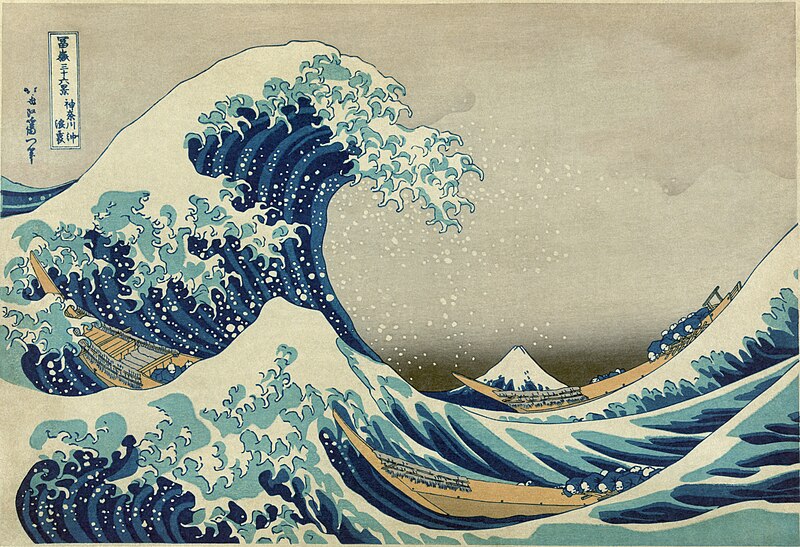
Great Wave at Kanagawa*
Living in this floating world in reality, is being set adrift.  As a sailor, I can tell you that being adrift is about the slowest you can move and still be terrified that you're either unavoidably going to hit something or conversely never hit anything again.  Even when the helm responds, conditions may be such that that desire of direction is ineffectual in practice.


As I am currently seeking employment, I can't make future commitments and jot them down on a calender as I have no idea what my future holds.  At this time my role as tenzo has many requests for my services coming into view and as paying the bills rates higher on my priorities, I'm not able to make the commitment now even if I have the time when it is requested.

This is both frustrating and disappointing as I not only take my role and responsibility seriously, my pleasure and generosity associated with it come from a very deep and sincere place inside of me.  The sangha needs me and while things can happen without me, the greater burden placed on others will essentially be my fault if I'm not able to answer the call.

In my continuing exploration of non-duality, I see this relating to the polarity of form and emptiness.  I see lack of form, and thus a great deal of emptiness in my days.  I still get things done, even if it's not always what I should be doing, but moments come and go regardless.  To restore balance, I need more form as my current situation is unsettling, like tumbling in the dark, or to return to the above metaphor: floating adrift.

I see the need to recognize both form and emptiness as the world doesn't end if a form falls apart, but right now the world is difficult to start without forms.

Floating is nice, but it's good to have an anchor or two.

-------------------------------------------------
*This iconic Hokusai print, borrowed from Wikimedia Commons, is an ukiyo-e image depicting boats of fishermen struggling against the sea.  It shows a wonderful example of when it is appropriate to be flexible.  These fishermen are brave and skillful, as they must push through the breakers to reach their fishing grounds.  But there is a difference between being flexible and flaccid.  Without effort, they would capsize and be crushed.

Monday, March 14, 2011

Words, What's the Point? or Stupid Non-Duality...

I'm sure it's just a stage, like those one passes through when dealing with grief.  If that's the case, I have no choice but to fully throw myself into it and wallow in the frustrating paradox that is coming to grips with non-duality.

A big issue with Zen teachings is their stereotypical "illogical" nature made famous by the promotions of D.T. Suzuki.*  I had pretty much wrapped my mind around the emptiness of words and how we shouldn't rely on them when practical experience is a better teacher, but having experienced directly a handful of things that, in the light (or should I say "darkness") of non-duality, are inexpressible in words; my heart has not been so pliant.

Remembering a post by Shundo at The Ino's Blog concerning the use of jargon at San Francisco's City Center, inspiration struck.

We're always told that only a realized teacher can confirm "enlightenment" experiences and I'd more or less just taken this on faith.  They see that you get "it" enough, so yeah, the experience is valid.  But when it comes to koans not having fixed answers, I just didn't understand how this could work.

Just as a visitor wouldn't really know what the "doshi door" was without experiencing it, we can't really know the true nature of anything without experiencing it.  People can give descriptions, even show you pictures, but until you actually experience it, your only reference of the door is secondary sources, shallow imitations of the real deal.

In having misunderstands/disagreements about the meaning of terms, or even whole and fundamental teachings, with people online and in person, I do and have realized that we really are talking about the same thing, but that our concepts of what the words we use mean, are different.

I've long felt that people are who they are because they are comprised of their experiences, built up as individuals by a lifetime of events and influences.**  All of these situations have determined how we see the world and how we define the things around us.

Words, being abstract representations of these experiences, only have meaning because we have all agreed up their meaning, this is how language develops.  Someone says, "This is a ball, from now on, you see one of these and call it a ball, I'll know what you're talking about." Everyone agrees and we have one idea of what a ball is.  Something else shaped the same way, the same size, color and everything pops up and we have a dilemma. Do we agree that this new object is a ball, too, or do we call it something else?  So now we have criteria for what a ball is.***

But abstract ideas add a new dimension to this because we can't point to them.  (I could write a whole book on this phenomena, but then I'd have wasted my time because that's what Zen and the Art of Motorcycle Maintenance is about.)  I'm very fond of the idea of words as fingers pointing to the truth so this is a metaphor that pops up for me a lot.

Each moment of our existence is different from those around us, so the rules that we assign to our existence are different.  Most notably the difference between right and wrong is a good example.  Given an individual's upbringing the appropriate way to interact with authority figures can be drastically different, giving them a different sense of right and wrong.  I could go deeper into this, but I hope you get where I'm going.

When it comes to our experience of reality, this causes trouble until we have an experience in which we glimpse its true nature.  The words we use to communicate our experience to a teacher are direct references, and if we're lucky our words will point at the same thing our teacher's understanding looks towards.  Until we have that experience ourselves (like seeing the doshi door) our fingers just point at other fingers and our experience isn't direct.

(I hope you're still with me.)

Words, unfortunately will always just point, so all I can do is point and hope you understand, not what I'm pointing to, but that this sign I'm holding up is understood to even point.  So I'll just keep pointing, not expecting anyone to understand or even read this blog just like I did at the very beginning. 

Maybe the mountains are becoming mountains again, they sure seem to be trying.

-----------------------------------------------------


 *I've more or less given up on his works as a practical reference as I don't think he really knew what he was talking about.  Sure in a talking "about" way, he did.  He was talking circles around the truth, but never pointing directly at it.  Scholarly analysis just doesn't do Zen justice and as a practitioner, this was one of the first gates I passed through finally after ten years of intellectual study.

**Later Buddhism gave me a framework for expressing this. Since these are the heaps/aggregates/skandhas, that are fundamentally empty, the "face we had before our parents were born" is like the blank canvas or empty vessel that all of this goes into.  This is not however, a belief of environment over genetics determining who we are since genetics have evolved as a response to the environment of our ancestors ("before our parents were born") as well as forms of life and even the planet, then stars, making the history of the entire universe influential in who we are in every moment of our lives.  Thus, that "face" is the self independent of phenomena, the absolute primordial inexpressible action/actor.

***When I took an intro to philosophy class in college, one of our discussions was an epistemological argument concerning whether or not it was possible to distinguish whether one of two objects, having identical properties, was removed a second time from a box or if it was the one left behind the first time.  Hating hypothetical questions for their assumptions, I questioned whether one of the identical properties was that it was really one object existing simultaneously in two places.  This blew the lid off the conversation, effectively ruining it, but it's a hypothesis that's stuck with me. Eventually, I mean to post about this. (if you have a comment about this, just encourage me to write the post and we'll discuss it then)

Saturday, February 19, 2011

Response to "Lineage Delusions: Eido Shimano Roshi, Dharma Transmission, and American Zen"

Before I run off to next week's retreat with Tenshin Reb Anderson Roshi, I've got to loose these feelings about this highly recommended (and agreed with by those who have recommended it to me) essay/article by Erik Fraser Storlie on Sweeping Zen concerning the controversy surrounding Shimano Roshi as well as the validity of Dharma Transmission as an institution and its role in the future of American Zen.

I happen to strongly disagree with almost every argument in this piece and find it borderline offensive.

First of all, I'd like to address the statement that spiritual leaders of Eastern traditions in America engage in inappropriate behavior which is then explained away as a teaching is taken out of context.  This implies that these teachers willingly and intentionally engage in these behaviors for the express purpose of teaching us a lesson.  I find this as ridiculous as the author, but not for his reason.  These behaviors are referred to as teachings in an accidental way.  Happenstance has provided us with this series of events, and as good bodhisattvas, we see the dharma gate and walk right in.  These are not intentional lessons, they are examples of imperfect people doing imperfect things, which I'll get back to later.

I don't know the specifics of the situation's history or supposed cover up, but for my point, I don't think that matters.  I may not even have been in the know about this scene for very long, but what I do know is what I've been told and what I've experienced for myself.

Do I think it's a shame that unsuspecting individuals were hurt by teachers of the practice that I believe in and follow myself taking advantage of their authority? Yes, I do and it is tragic.

Do I think this is a one way street where an irresistible authority overwhelmed an individual, who even if not helpless and trusting, would have been seduced anyway?  No, I don't.  But that also doesn't mean that this wasn't a case of a vulnerable and trusting person being taken advantage of.

On this point, I'd have to agree with Brad Warner that authority figures only have the power that we agree to let them have.  This opinion is not coming from some sycophantic blogger that can't think on his own; this makes real sense and can't be argued against. 

I have been taught, and verified myself, that Zen is about discovering the illusionary quality of what we hold to be true.  That, like scientists, we should doubt what we observe (or are told) until we're able to confirm it through experimentation and thus experience the truth for ourselves.  It's not about dismissing the objects of the senses, but just not blindly trusting them.  Given these instructions, why would I wholeheartedly and blindly agree with anything a teacher told me without testing it myself?

I want to know where these "masters" are that are said to:

“dwell in the absolute,” or is a lineage holder in “crazy wisdom,” or can raise the kundalini energy, or read our chakras and past lives, or help “burn up” our karma, or is offering to share our wife, husband, girlfriend, or boyfriend so as to assist us in breaking our unfortunate attachments – all of this, of course, to stretch us beyond our parochial notions of right and wrong and bring us to the ultimate attainment enjoyed by the master himself (the master almost invariably being male)
  - cause I'd say "thanks, but I think samsara's a better deal."  Sure some people would fall for this, but surely not enough serious practitioners under him, and especially not his peers or superiors.  To what kind of ridiculously poisonous teachers has the author been exposed?

Sure, tradition expresses such poetic sentiments concerning Zen teachers as "dwelling in the absolute" or "realized masters," but this doesn't make them perfect.  Anyone who has spent any amount of time around a teacher with their minds open will have seen them make a mistake, this doesn't accord with perfection.

These individuals are recognized as having "realized" the true nature of the Dharma, not "actualized" it; they're not assumed to be Buddha.  They're still working on life.  Just because they know all the rules to the game now, doesn't mean they can win.  Because they're recognized by their teachers as knowing the rules, they're allowed to teach them to others, but enlightenment cannot be taught, you have to win it yourself.

We play the game against Mara, and the more we play the better we get.  The Buddha just got so good that Mara couldn't beat him anymore.

So the matter of authority and the legitimacy of Dharma Transmission comes down to one question: Do the rules this teacher is telling me sound like they'd help me win this game against suffering?  We must further explore and inform our answer to this question by asking if it looks like the teacher is, in fact playing by those rules and do they seem to be winning themselves.  Yes, this will take a serious investment of time and effort for us to find out for ourselves.

As the author states "the most important thing we can bring to these inquiries ... is our sincerity and selflessness."  There's where the sincerity comes into play.  If we're serious about getting to the root of it, we must be sincere in our practice.

But we must tie that in with selflessness, if things don't seem right, we should set aside our egocentric opinions and accept our losses, remembering the lessons we've learned and move on. This is where so many get caught up and look the other way, allowing abuse to happen.  If we are sincere about our practice, as in defining what I expect my teacher to teach me as Soto Zen in the lineage of Suzuki Roshi, we would question the teachings if they are not in accord with our ideal.  If the teacher's answer is unsatisfactory, we should go to others with our questions, or at worst, concerns.*

This presents a contradiction to the author's statement implying that American Zen is not democratic, contrasting it with the first pioneers seeking religious freedom.  "Their polity was congregational, where the minister served at the pleasure of the congregants."  We're not enslaved by our teachers.  If I didn't like a teacher, I'd leave, even if it means going without.  If enough people "vote with their feet," the powers that be will question the right for that teacher to be teaching unsupervised.

Are there individuals that have the authority to teach who still struggle with their own practice?  I challenge anyone to show me one who honestly believes that he or she doesn't.   Are there individuals who have the authority to teach who shouldn't?  Show me any organization with teacher student/relationships that doesn't.

To dismiss the tradition of Dharma Transmission for this reason is ridiculous.  In every game there are players who try to play by their own rules, sometimes they even win, but if I may reverse a popular saying, "Hate the player, not the game."  What makes individuals, and even organizations, believe that if they set stricter rules, these rule breakers will follow them, they'll just get sneakier about it.  Why do you think lawyers have such bad reputations?  It's because they know all the rules.

The author also seems to believe that Dharma Transmission is also holding American Zen back, preventing it from speaking to people, or becoming "more than an odd, idiosyncratic subculture."  It speaks to me!  It speaks to countless numbers of American, as well as European and even African practitioners!

What keeps it the way the author views it is that it's misunderstood.  How can you blame the phenomena of Dharma Transmission on this when the average American has no idea what that is and when asked what they think about Zen, they're likely reply is "Isn't that some form of Buddhism... like from Japan?"   What does Dharma Transmission have to do with that?

Yes, it's from Japan.  Yes, we do dress weird and chant funny things in Japanese and sometimes Pali.  We bow to statues have other weird rituals.  But these are forms, and what does the Heart Sutra say about forms?

They're all empty!

The average American is not aware of this beautiful and subtle teaching.  They live in a world where people that do those types of things often take offense when they're told how ridiculous that kind of behavior is and has no basis in reality, while our tradition celebrates that fact and still takes it seriously!

One interpretation of the first Pure Precept, usually read a vow against doing evil, is to embrace and sustain all forms and ceremonies.  I find these two related because evil can be equated with chaos.  While we recognize the emptiness of these forms and ceremonies, to act formlessly would be chaotic, and dissrespective of nature which is both chaotic and harmonious.  We practice these specific forms out of tradition, knowing that it's their purpose of practice that matters not their content.

These traditions include Dharma Transmission which is a form as well.

 Does it really matter if Shakyamuni attained a mind of absolute perfection?  Does it really?  Right here in the moment where we're told to live?

And how could Mahakasyapa have "attained this perfect mind" if there's nothing to attain?

The rationale behind celebrating a "an unbroken chain of such 'mind to mind' transmissions has descended, generation after generation, in a known lineage, down to today’s living dharma heirs" isn't to show how important and pure the teachings have been throughout the ages, it's to show us today how importantly we should consider the business of involving ourselves in that legacy ourselves.  Sure, it's a romantic notion that adds depth and meaning to the tradition, but do I need to debate whether or not some person who lived halfway around the planet 1500 years ago with a name I can't even pronounce, living in a world I can never understand not only realized his own Buddha nature under the guidance of a realized teacher, but was successful in pointing a successor to the same realization?  Does it really impact the veracity and effectiveness of the teaching?

Even if the lineage existed historically and somewhere along the line there are a few spots where Dharma Transmission was incorrectly issued, if someone learns enough of the rules to win, they may figure out some of the others on their own.  What really matters is winning against delusion.

One thing I do agree on, is that author was correct in refusing Dharma Transmission, not for the reasons that would immediately come to mind, though.  I respect him, and he probably deserves it.  I still accept his teachings as valid, and as an experienced Zen practitioner in the same general lineage as myself see it as Zen.

Why do I think it  was the right decision, then?  Because to him it's a prize to be won in an ass-kissing contest, a piece of paper to be held up declaring "listen to me, what I say is true and unquestionable!"  If that's how I viewed it, I wouldn't want it either.  Accepting lineage papers in that mindset, they would be good for nothing more than wiping the Truth of the buddhadharma off the ass that is the ego.

-------------------------------
*To preserve the good name of our ideal, actions to defend it must take place.  If someone says what they're teaching is Zen or Buddhism, and it's not or they're admitting to trying to make it less esoteric or more accessible, then it's not Zen or Buddhism.  I have no problem with the majority of people doing this, they just shouldn't call it what it's not.
Thursday, February 3, 2011

De-Sire Is Not a River in Egypt

There's a lot of talk about desire, wanting, and detachment in Buddhism that's often misunderstood.  Desire is considered the cause of suffering so a lot of people think we're supposed to get rid of it.

But what makes it so bad?  We're not ascetics so getting rid of it is a little extreme.

I've recently been finding a lot of interesting dualities, the kind that exist as opposite sides of the same coin.  Desire and denial are two that have popped up.  Desire is usually associated with wanting, you give in to it and end up wallowing in excess.  Give in to denial and you go the other way, living with nothing.


In the whole mix of mindfulness and living in the moment, denial and desire are very much related. 

When we desire something, it's usually because we're unhappy with the way things are.  We want something we don't have, or want something to be different in the past, present or future.  In this way, desire is a denial of what really is.  We deny the reality of the moment.


Getting rid of desire is like taking medicine to control the symptoms rather than the disease.  Sometimes a headache is just a headache, just as wanting that flashy phone or juicy cheeseburger is just a want.  But other times a headache is something more.


Families or loved ones are often considered one such "headache" by some.  They find distress in loving their families when being told to give up attachments and desires.


In this situation what is it that desire denies?  Our desire to care and protect those we love is a good thing, giving us reason to be balanced and productive in life.  Any denial involved in doing so is healthy, usually considered compassionate. 


Where desire causes problems is when they're not met.  All desires are are preconceived notions of what we want life to be.  Just like all preconceived ideas, they're usually not founded in reality.  Even if we get what we believe our desires to be fulfilled, they almost never match up with what expected and even if they do, the thrill dissipates over time.


This is the type of desire we're warned against.  It'll still happen, there's no way to get rid of it.  We're hardwired to want more because our bodies can never be permanently satisfied.


This is where attachment comes into play.  If we get hooked on the dissatisfaction with not having out desires met, we continue to deny reality.  This is the root of suffering.  Having desires is okay, it's not letting go of them when they don't measure up.


Taking families as an example, no one's family is perfect.  The one's that are happy with their families are the ones that accept this.  Letting go of that standard prevents dissatisfaction.


Standards are relative and mostly arbitrary so it's not the desires that cause the issues so much as our unwillingness to realize the nature of our standards and holding on to them.


Reality is as it is, our actions have brought us to where we are.  Denying reality puts us at odds with truth, making us unhappy.


Only through being aware of this gives us the perspective to correct our views and behaviors.

Saturday, December 11, 2010

You Can Only Change Yourself

Day one of our 2nd (annual? with fingers crossed) seminar with Shihan Hiroshi Ikeda and this is one of the things I'm walking away with: "you can't change others, only yourself."

Ikeda Sensei's specialty is internal work and he's known for this even outside of Aikido circles.  Internal techniques involve externally unobservable changes made in the dynamic between two people and Aikido would not work without it.  In my experience, it has mostly to do with the power of the mind expressed through an intention, usually referred to esoterically as ki or ch'i.  From the outside it looks fake, but only after you've been on the receiving end yourself does the magic become real.  Many of us were lucky enough to be exposed to this last year but it was so new we had no idea what was really going on.  With a year's time to work with it, the things he says and demonstrates make more sense quicker.

Like everything else in Aikido, this message functions on many levels even if it was only presented as a guideline fundamental for physical technique.  In context, he was telling us when faced by a physically stronger opponent, we can't move them.  The only way to exert our will is for us to move ourselves, and if we're successful in making a connection, they will follow.

Out of the context of physical confrontation, taken into everyday life, this is a powerful lesson.  In Zen we see it pop up quite often.  We can only hope to control ourselves, if we're able to control anything.

My Aikido teacher reminds us often that the first step in self defense is defending us from ourselves, echoing the same idea.

In Zen, we accept that the world around us exists, but that it is devoid of meaning until we fill it up with our ideas.  Most of this is unconsciously done with pieces of our lifetime's worth of experiences fit together like a puzzle.  The purpose of Zen practice is to tame the unconscious so that we can choose how we define the world around us.  By changing our outlook, we change ourselves and thus the world not only for ourselves, but in a smaller way for everyone else who feels the consequences of our actions.

The Mahayana perspective is that of saving all sentient beings along with ourselves, but we have to straighten out our own mess first.  By doing this we make the world a better place, doing just what we can is all we can do.  In its outward form, Aikido is about fixing the mess of someone wanting to hurt us.  On a subtler level it's about resolving the conflict with another by acknowledging we are not the omniscient and omnipotent center of the universe; we must humble ourselves to get what we want.  In reality this manifests in both Zen and Aikido (as philosophy) in the fact that if we let the ego run untamed, we will always be in conflict with the universe.  To change the external, we must start with what have and change the internal.

And just as in both Aikido and Zen, the work is never done.  Every new situation will suggest excuses to us, "he told me this," "I got stuck in traffic," "I didn't know," "but she started it.." Changing the self requires constant effort because the self is not static, each moment is completely new.  Sure, we have habits and patterns, but that is all they are; there will always be anomalies.  And just like genetic mutations, if left unchecked, they will spiral out of control until we don't recognize our own behavior any more.

So instead of letting blame slide, don't let yourself be the victim.  Change what you can: yourself.

Wednesday, December 8, 2010

The Form and Emptiness of the Teacher/Student Relationship

According to tradition, the "proper" way to become a student of Zen after finding a teacher is to present him or her with a small gift and formally request to be his or her student (I guess "traditionally" it would have only been "him" and "his," but whatever).  Being a sucker for traditions, I couldn't allow myself to proceed any further in my studies, especially as I approach closer to receiving the Precepts, without doing this.  I don't know how far this practice will take me, but I don't want to break with tradition.

So I did this yesterday.

During dokusan, I presented my teacher a small memento of a powerful experience that I had had many years ago and asked to be her student.  I was of course accepted, since this is essentially a formality and I had already been her student for some time.

There is no way of me knowing how common this practice is in my sangha, let alone in the world today.  I consider this practice to be more a cultural thing; a holdover from different times when becoming a student was an absolute thing where the request was akin to signing a lease to live in a monastery.  In today's world people wear many hats and dropping in on a teacher every once in a while is more the accepted practice.  Here in the United States, as Zen is still finding its identity, our American practices do not expect such a formal request.  For many people, even just the need for a teacher isn't all that strong. I wouldn't have known about this formality if I hadn't read about it in some books.  It doesn't really matter to me whether any of my fellow students have done this at all, but I felt it was right for me.

So what's the big deal?  I was already a student, why make the request and present a gift?

The relationship between student and teacher is just as empty as anything else.  This doesn't mean that it doesn't matter, but that it's like a bucket labeled "teacher/student relationship."  It has no fundamental definition.  Until we put our own thoughts and feelings as to what it means to us, the bucket remains empty.  Until now, my bucket held the idea that here was a person dedicated to spreading the Dharma and saving all beings living a vow to help anyone asking for it.  We were fellow travelers on the road and I was being offered advice.

To me the gift represents the idea that this request is more than just a verbal thing.  It shows a higher level of commitment. Time and effort were spent pondering it and I am giving something of myself to this relationship.  The formal request is just as symbolic.  To surrender to the idea of needing help to walk the path is humbling.  To make this request to a teacher is to both admit your own humility but to also acknowledge your worthiness of pursuing the path.  Until we can do both things we will never quite arrive at our destination.

With this formal acceptance, my bucket holds some new ideas.  My actions signal my commitment to the path and that I don't intend to just wander off.  Because of this, a new intimacy exists.  While I still consider my teacher as a fellow traveler, I now fully acknowledge her as one who has "gone before"* and I will wholeheartedly follow her lead.  More than just pointing her finger to the truth for me to see, I have given her my hand so that she may point my own finger. 

Our origins are different so in places the route will be completely different.  Where it's the same, the road may have changed a little since she passed through. While my exact destination may differ, the direction is the same and I am one step closer to getting there.

------------------------------------------------------
*a rough translation of sensei