Now that I've got the posting of my interview taken care of, I've got a lot of catching up to do. Last weekend we had guests from several places come to stay at the Zen Center for a priest ordination. They had to eat, so I answered the call to prepare a few meals for guests and residents.
In the almost twenty years that I've been cooking, half of that professionally, I've never cut myself with knife anything more than a scratch. So within fifteen minutes of prepping for breakfast I dragged my knife across the tip of my finger, cutting deep. Of all the places and times for it to happen, it happened at the Zen Center, where cooking is emphasized as mindful practice. I'm professionally trained in various knife skills and even I managed to cut myself just slicing apples. I wouldn't necessarily call it hubris, I was still being careful, but my mind drifted. This served as a painful reminder that it doesn't matter how experienced you are, you always have to pay attention to what you're doing.
I disrespected my knife by not giving it my full attention and it bit me.
Knowing that the painful lessons are the ones that we're most likely to remember, I think (hope) that I learned my lesson. A few days later as I was watching it heal, I wondered if it would leave a scar. I've never been one for battle scars from the kitchen as many line cooks are, but I thought a permanent mark might be fitting as a reminder to remain present while cooking.
The thought of scarred fingers took me a few digits over to a mark on my index finger about an inch long and an eighth of an inch wide with three pairs of dots along side. This is an old scar from my childhood that resulted from some poorly thought out creativity.
I used to make all kinds of things from the cardboard that came in my dad's laundered work shirts. On this occasion I was trying to poke a hole in a piece with one blade of a pair of scissors. I was successful in making the hole, but on the other side was the gap between my index and middle finger. The gap wasn't wide enough for the blade to miss slicing my finger.
At first I thought it was just a scratch... until I moved the cardboard away. There was so much blood! Before my mind could make sense of it, there was blood all over the desk where I was sitting. I'm not sure if it actually hurt as much as I thought it did at the time, but seeing that much of my own blood incited panic.
This happened at the school where my mom was teaching at the time, on the day before school started. I know that she was in a meeting, but I don't remember all of the details between seeing the blood and sitting in the trauma room at the ER other than the pain and terror. By the time the doctors came in to stitch me up, it'd worn off. I don't remember if it still hurt, but I'd calmed down and was hoping it wasn't going to require stitches.
The cut was deep. When the bleeding slowed and they cleaned the wound I could see through the layers of skin into the meat. The doctors decided to skip injecting the local anesthetic and just poured it right in, saving me the added trauma before the sutures.
Without the pain as a distraction, it had become a learning experience for me. How often do you get closer than front row seats to a finger getting stitched back together? It was interesting and made for a great story on the first day of school back from summer vacation. Plus, on the way home from the hospital all I could think about was the sight of some poor second grader showing up for the first day of class to a dried pool of blood on his desk and floor. (I was told later that it had been cleaned up shortly after we'd left for the hospital.)
It's weird how life teaches us lessons. We're always supposed to learn from our mistakes and sometimes we do, but other times the point just doesn't get driven home enough. Sometime life uses erosion and slowly etches the lesson in over time, but other times it cuts right to the chase and splits us right open.
I'm not sure if my recent cut will leave a scar, so its lesson may come and go. What I do know is that I've sure watched where my fingers are before poking a blade through an object over the last twenty some years.
Showing posts with label life before zen. Show all posts
Showing posts with label life before zen. Show all posts
Sunday, November 21, 2010

Monday, November 1, 2010
It Is What It Is Because It Is What It Isn't, Isn't It?
Confused?
A lot of people think that Zen is supposed to be confusing, and it can be. It's not intentional but pointing directly at the truth is very specific and precise. So much so that until you actually experience, it won't feel true. Maybe intellectually you can wrap your mind around it as being possible, but it won't feel true like gravity feels true, or pain, or the taste of fresh strawberries.
Words lay out the boundaries providing the frame for understanding, but without direct experience we can't see the picture within that frame. The best we can do is describe it with metaphors, telling parables and stories of the moment of realizations of those who've come before.
For years, I'd read all these stories and metaphors, wrapping my mind around them but recently I've experienced my mind becoming them. Something will fall into place and as I put together the words to describe it, I realize the descriptions already exist. Not only do they exist, but they're pointing exactly to it.
It's like two people bird watching. One spots a bird and tries to describe to the other where it is among the foliage. Pointing directly at it, it remains unseen by the other. "It's right there!" they exclaim. And of course, it is right there just waiting to be seen. The second person may even be looking right at it, but not seeing it because of distracting foliage breaking up the bird's silhouette.
As I listened to Sojun Roshi's talk on the Middle Way that I wrote about last week, I heard things what he was saying but not always what he was telling me. During the question and answer after the talk, I brought up my thoughts about things being just as much what they aren't as what they are and all that.
I knew he had been a painter earlier in his life so I brought up something related that I had struggled with years ago. I mentioned that when I was studying fine arts, as I was developing my own "style," I struggled with portraying the figure and ground* as not being separate. I became frustrated because, visually this is impossible. By definition, the figure and ground have to be visually distinguishable or the canvas would be blank or at least a solid color.
This was an idea informed by my intellectual understanding of Zen and Taoism about the interconnectedness of everything, the lack of discrimination in an existential way.
After I'd said this, he told me I should try and go back to painting. I realized at this advice, that Zen does not teach that reality is homogeneous, just that things are not separate. The figure in a painting exists as figure because it is not the ground and vice versa, but the painting is nothing without them both. The existence of the painting relies on the existence of the figure and the ground in relation to each other. Every painting communicates this idea, we just don't see it even though we're looking right at it.
I could be dramatic and say it struck me like a bolt of lightning, but it wasn't like those Windows 7 commercials. I wasn't suddenly prettier and surrounded by light with awe inspiring music in the background. It was just the truth, as I'd been looking at it but never seeing it.
A few other examples of this came rolling out of my brain soon after this.
The first is very Taoist, in fact it's a whole chapter from the Tao Te Ching. A cup only functions as a cup because of the absence of material inside, such is the hole for the spoke of a wheel as well.
Another that goes back to my own artistic bent is that of flavor. When cooking, everything has some sort of flavor. Those that are successful at composing new flavors rely just as much on what they include as what flavors they exclude. The true flavor of a well marbled piece of beef relies on not smothering it with butter or barbecue sauce or even ketchup. Some foods call for this, and sometimes even a nice piece of beef. But in true flavor composition, these things need to be recognized.
Speaking of composition, music is the same way. A song is just as much the rests between notes as it is the notes themselves. Take out the pauses and the song is no longer the same song.
I could go on like this forever, but it doesn't matter.
This seems to be one of the problems with promoting enlightenment experiences, satori or kensho. You convince someone they're looking for something in particular when it's right in front of them the whole time, they might not recognize it when they actually see it.
Ever been in a situation similar to the bird watching one above? As the second person, you finally see what you're looking for and get upset with the directions towards whatever's being pointed to? "Oh, that right there! That doesn't look like one of those, you should have said it looked like this right next to that."
Get the picture? Look for yourself, if you keep looking you'll see it. Remember that others can only point from where they're standing, sometimes perspective gets skewed. Their descriptions might not make sense now, but when you no longer need them, they will.
---------------------------------------
*The figure is whatever you're supposed to be looking at while the ground is what is behind the figure. Optical illusions usually play on this interaction with an effect called "figure-ground reversal." This phenomena inspired my desire to eliminate this confusion.
A lot of people think that Zen is supposed to be confusing, and it can be. It's not intentional but pointing directly at the truth is very specific and precise. So much so that until you actually experience, it won't feel true. Maybe intellectually you can wrap your mind around it as being possible, but it won't feel true like gravity feels true, or pain, or the taste of fresh strawberries.
Words lay out the boundaries providing the frame for understanding, but without direct experience we can't see the picture within that frame. The best we can do is describe it with metaphors, telling parables and stories of the moment of realizations of those who've come before.
For years, I'd read all these stories and metaphors, wrapping my mind around them but recently I've experienced my mind becoming them. Something will fall into place and as I put together the words to describe it, I realize the descriptions already exist. Not only do they exist, but they're pointing exactly to it.
It's like two people bird watching. One spots a bird and tries to describe to the other where it is among the foliage. Pointing directly at it, it remains unseen by the other. "It's right there!" they exclaim. And of course, it is right there just waiting to be seen. The second person may even be looking right at it, but not seeing it because of distracting foliage breaking up the bird's silhouette.
As I listened to Sojun Roshi's talk on the Middle Way that I wrote about last week, I heard things what he was saying but not always what he was telling me. During the question and answer after the talk, I brought up my thoughts about things being just as much what they aren't as what they are and all that.
I knew he had been a painter earlier in his life so I brought up something related that I had struggled with years ago. I mentioned that when I was studying fine arts, as I was developing my own "style," I struggled with portraying the figure and ground* as not being separate. I became frustrated because, visually this is impossible. By definition, the figure and ground have to be visually distinguishable or the canvas would be blank or at least a solid color.
This was an idea informed by my intellectual understanding of Zen and Taoism about the interconnectedness of everything, the lack of discrimination in an existential way.
After I'd said this, he told me I should try and go back to painting. I realized at this advice, that Zen does not teach that reality is homogeneous, just that things are not separate. The figure in a painting exists as figure because it is not the ground and vice versa, but the painting is nothing without them both. The existence of the painting relies on the existence of the figure and the ground in relation to each other. Every painting communicates this idea, we just don't see it even though we're looking right at it.
I could be dramatic and say it struck me like a bolt of lightning, but it wasn't like those Windows 7 commercials. I wasn't suddenly prettier and surrounded by light with awe inspiring music in the background. It was just the truth, as I'd been looking at it but never seeing it.
A few other examples of this came rolling out of my brain soon after this.
The first is very Taoist, in fact it's a whole chapter from the Tao Te Ching. A cup only functions as a cup because of the absence of material inside, such is the hole for the spoke of a wheel as well.
Another that goes back to my own artistic bent is that of flavor. When cooking, everything has some sort of flavor. Those that are successful at composing new flavors rely just as much on what they include as what flavors they exclude. The true flavor of a well marbled piece of beef relies on not smothering it with butter or barbecue sauce or even ketchup. Some foods call for this, and sometimes even a nice piece of beef. But in true flavor composition, these things need to be recognized.
Speaking of composition, music is the same way. A song is just as much the rests between notes as it is the notes themselves. Take out the pauses and the song is no longer the same song.
I could go on like this forever, but it doesn't matter.
This seems to be one of the problems with promoting enlightenment experiences, satori or kensho. You convince someone they're looking for something in particular when it's right in front of them the whole time, they might not recognize it when they actually see it.
Ever been in a situation similar to the bird watching one above? As the second person, you finally see what you're looking for and get upset with the directions towards whatever's being pointed to? "Oh, that right there! That doesn't look like one of those, you should have said it looked like this right next to that."
Get the picture? Look for yourself, if you keep looking you'll see it. Remember that others can only point from where they're standing, sometimes perspective gets skewed. Their descriptions might not make sense now, but when you no longer need them, they will.
---------------------------------------
*The figure is whatever you're supposed to be looking at while the ground is what is behind the figure. Optical illusions usually play on this interaction with an effect called "figure-ground reversal." This phenomena inspired my desire to eliminate this confusion.
Thursday, October 21, 2010
Contagious Calmness
So, I've still got it.
One of the classes I'm taking right now is called A La Carte. It's really fun and easy (although sometimes frustrating) for those of us with industry experience. (A lot of my fellow students have never worked, or honestly will ever be able to hack it, in real restaurants)
Basically the class is divided into four groups of 4-6 people and we rotate staffing each portion of a restaurant at school. People can come and have a student prepared six course lunch served to them by students for only $10 per person. Each group rotates through hot station, cold station, dish pit, and service staff with the teacher, who actually is one, serving as chef. One of the added benefits for us industry pros is that the chef allows one of us to serve as sous-chef and expediter each class.
This position in a classically structured French kitchen using the brigade system is the chef's first officer. The sous-chef, or "under-chef" serves as a go between for the chef and staff, making sure things get done. In most kitchens during service time they act as expediter, taking orders from the waitstaff and communicating them to the kitchen then staging them for service and finishing them off by wiping plates and adding garnish.
This is what I got to do today. I've wanted to be expediter at just about every restaurant that I've worked in, but even though it takes a slightly different skill set than other positions, I was never taken seriously or believed in since I don't excel in back of the house* positions.
At school we don't have fancy computers to print out tickets so each server turns in a ticket for each table's order all at once. Normally each course has a separate ticket that goes out with the food. Instead the servers ask for each course to be "fired" and the expediter relays that to whatever station is responsible for that course. The station then prepares it and puts it in the "window" which is a shelf between them and the expediter. The expediter then wipes any drips and dresses the plate with any garnish to "sell" it in their own window between them and the servers or food runners.
Doesn't sound all that hard, does it? Well, tickets come in constantly as well as servers coming back on top of each other to fire different courses. Sometimes there are modifiers to an item, such as no bacon, a vegetarian substitution, or desired doneness. The expediter will "add on" another number of items to a station and the station will call back the order to confirm. If a certain number of items has already been called and more need to be added, the expediter will add on the new number and then add that to whatever has been already called, letting the station know how many they need "all day."
The expediter has to keep straight what's been fired and what hasn't yet, what's been sold to them and to what table it's going. Sometimes servers make mistakes and need an order "on the fly," or they have to go back to the table to let their guest know we're out of something because it wasn't sufficiently communicated to them that an item was "86'd" because the kitchen is out of it. There's all kind of slang that will put you "in the weeds" if you don't learn it quickly. On top of all that, in the real world, kitchens are a cesspool of machismo and trash talking is the vernacular. If you can't hold your own, the kitchen won't respect you and they'll still make work near impossible. It can get hectic.
I had five servers each with about three tables each ranging from one to eight people, which I was told was the most we'd had all semester. I think we served 37 people. Every one did a really good job and we got it done without any serious problems.
The thing that really pleased me was something that I hadn't heard in more than five years. Before he left, the chef thanked me for doing such a great job and keeping a cool head. The expediter has to have the strongest personality in the kitchen to keep things in control and he noted how well lunch service went despite issues in the dining room and the volume we did.
Back in the day, when I worked in a "quick service restaurant" (QSR, that's industry-speak for fast food. Seriously, there's even a trade magazine by that title) I really knew what I was doing. First of all, it wasn't really that complicated, but it was a lot of stuff to do and the volume a QSR can do during a weekday lunch can be insane. If all the pieces don't fall into place, it's very possible for it all to come crashing down. People freak out about irate customers, the grill person can lose count of how many patties are on the grill, there's a lot of stuff that can go wrong.
In my four and a half years of dedicated service, I had confidence in my ability. I take pride in my work and it showed. I'd show up with a job to do and the intent to get it done. Stuff happens, I'd push through it. Freaking out isn't going to fix anything. There were shifts where Murphy's Law was proved accurate and I just kept going. I had several managers over the years tell me that I was like a calming influence on the crew. The freaking out would begin, I'd come up from that first drive thru window (it's actually referred to as the "bubble") to help out and everything would calm down.
I enjoyed the work, it didn't pay well enough for me to stick around any longer, but I do miss it sometimes. Working the drive thru, I'd have nearly 120 brief conversations with interesting guests everyday. Through my back window I got to watch many South Texas sunsets.
The difference between that and what happened today was that back then my confidence was based on experience. I knew the limits and all the variables, and I could do the work. I knew I could because I already had. Today my confidence was a little of that, but it was mostly just guts. There were a few times when I'd look down at the tickets and couldn't remember what they hell I'd called for or sold or anything. I'd take a breath and attack the situation one thing at a time.
The funny thing about this was during my last dokusan ** this past Tuesday, my teacher asked me about whether or not I was paying any attention to my practice while at school. Sure, I find myself correcting my posture or watching my breath, focusing on just what I'm doing in front of me, but these aren't really new things. I enjoy what I do at school, so I'm usually pretty focused. It was a difficult question to answer.
But that question Tuesday really primed my mind to be aware of what was going on when the going got tough today and it was nice. I didn't have the option to freak out and just run away, I mean I did.. but not really. I had to just keep going, and I did.
Keeping your head in a situation, especially one where everyone around you is losing it, can really impact how things will pan out. I really feel this is one of the best ways my practice shines in my life. This is the Bodhisattva way and saving all beings really does start with yourself. By improving my ability to keep my cool, I've saved others from losing it. The effort really pays off.
So keep two things in mind.
The first, next time you go out to eat, whether full service or just the drive thru, yeah the people working there may be idiots screwing everything up, but it's a tough job that a lot of people don't appreciate. Be nice to them, pissing off the people that feed you is never a good idea.*** Food service professionals work long hard hours in hot cramped quarters so that others can enjoy a nice meal before heading to the movies with their sweetie after making probably better money sitting in an air conditioned office in a nice comfy chair crunching numbers on a computer.
Second, be mindful of how your attitude affects those around you. It can be pretty easy to just go with the flow and let it all go to hell, but with just a little effort you can turn it all around. Even if no one else realizes it or appreciates, you'll know.
------------------------------------------------------
*"Back of the house" refers to the kitchen, while "front of the house" refers to the dining room. Traditionally the maître d’hôtel, "master of the hotel/house"or maître d' for short, is responsible for the front and the
chef de cuisine, or "boss (chief) of the kitchen" is responsible for the kitchen with various other chefs under him.
*** While spitting in food or other such childish things are actually considered food tampering and a felony, there are things they can do that can't be prosecuted. Orders do honestly get mixed up, but not all the time, fixing it takes time and even if it's comped you're never getting that time back. What time did that show start again? Do you still have time to eat your food before you have to get back to the office?
-------------------------------------------------------
Forgot to mention post at Dangerous Harvests with a similar theme that I enjoyed. I know I never seem to mention anybody else, but it just happens that way
One of the classes I'm taking right now is called A La Carte. It's really fun and easy (although sometimes frustrating) for those of us with industry experience. (A lot of my fellow students have never worked, or honestly will ever be able to hack it, in real restaurants)
Basically the class is divided into four groups of 4-6 people and we rotate staffing each portion of a restaurant at school. People can come and have a student prepared six course lunch served to them by students for only $10 per person. Each group rotates through hot station, cold station, dish pit, and service staff with the teacher, who actually is one, serving as chef. One of the added benefits for us industry pros is that the chef allows one of us to serve as sous-chef and expediter each class.
This position in a classically structured French kitchen using the brigade system is the chef's first officer. The sous-chef, or "under-chef" serves as a go between for the chef and staff, making sure things get done. In most kitchens during service time they act as expediter, taking orders from the waitstaff and communicating them to the kitchen then staging them for service and finishing them off by wiping plates and adding garnish.
This is what I got to do today. I've wanted to be expediter at just about every restaurant that I've worked in, but even though it takes a slightly different skill set than other positions, I was never taken seriously or believed in since I don't excel in back of the house* positions.
At school we don't have fancy computers to print out tickets so each server turns in a ticket for each table's order all at once. Normally each course has a separate ticket that goes out with the food. Instead the servers ask for each course to be "fired" and the expediter relays that to whatever station is responsible for that course. The station then prepares it and puts it in the "window" which is a shelf between them and the expediter. The expediter then wipes any drips and dresses the plate with any garnish to "sell" it in their own window between them and the servers or food runners.
Doesn't sound all that hard, does it? Well, tickets come in constantly as well as servers coming back on top of each other to fire different courses. Sometimes there are modifiers to an item, such as no bacon, a vegetarian substitution, or desired doneness. The expediter will "add on" another number of items to a station and the station will call back the order to confirm. If a certain number of items has already been called and more need to be added, the expediter will add on the new number and then add that to whatever has been already called, letting the station know how many they need "all day."
The expediter has to keep straight what's been fired and what hasn't yet, what's been sold to them and to what table it's going. Sometimes servers make mistakes and need an order "on the fly," or they have to go back to the table to let their guest know we're out of something because it wasn't sufficiently communicated to them that an item was "86'd" because the kitchen is out of it. There's all kind of slang that will put you "in the weeds" if you don't learn it quickly. On top of all that, in the real world, kitchens are a cesspool of machismo and trash talking is the vernacular. If you can't hold your own, the kitchen won't respect you and they'll still make work near impossible. It can get hectic.
I had five servers each with about three tables each ranging from one to eight people, which I was told was the most we'd had all semester. I think we served 37 people. Every one did a really good job and we got it done without any serious problems.
The thing that really pleased me was something that I hadn't heard in more than five years. Before he left, the chef thanked me for doing such a great job and keeping a cool head. The expediter has to have the strongest personality in the kitchen to keep things in control and he noted how well lunch service went despite issues in the dining room and the volume we did.
Back in the day, when I worked in a "quick service restaurant" (QSR, that's industry-speak for fast food. Seriously, there's even a trade magazine by that title) I really knew what I was doing. First of all, it wasn't really that complicated, but it was a lot of stuff to do and the volume a QSR can do during a weekday lunch can be insane. If all the pieces don't fall into place, it's very possible for it all to come crashing down. People freak out about irate customers, the grill person can lose count of how many patties are on the grill, there's a lot of stuff that can go wrong.
In my four and a half years of dedicated service, I had confidence in my ability. I take pride in my work and it showed. I'd show up with a job to do and the intent to get it done. Stuff happens, I'd push through it. Freaking out isn't going to fix anything. There were shifts where Murphy's Law was proved accurate and I just kept going. I had several managers over the years tell me that I was like a calming influence on the crew. The freaking out would begin, I'd come up from that first drive thru window (it's actually referred to as the "bubble") to help out and everything would calm down.
I enjoyed the work, it didn't pay well enough for me to stick around any longer, but I do miss it sometimes. Working the drive thru, I'd have nearly 120 brief conversations with interesting guests everyday. Through my back window I got to watch many South Texas sunsets.
The difference between that and what happened today was that back then my confidence was based on experience. I knew the limits and all the variables, and I could do the work. I knew I could because I already had. Today my confidence was a little of that, but it was mostly just guts. There were a few times when I'd look down at the tickets and couldn't remember what they hell I'd called for or sold or anything. I'd take a breath and attack the situation one thing at a time.
The funny thing about this was during my last dokusan ** this past Tuesday, my teacher asked me about whether or not I was paying any attention to my practice while at school. Sure, I find myself correcting my posture or watching my breath, focusing on just what I'm doing in front of me, but these aren't really new things. I enjoy what I do at school, so I'm usually pretty focused. It was a difficult question to answer.
But that question Tuesday really primed my mind to be aware of what was going on when the going got tough today and it was nice. I didn't have the option to freak out and just run away, I mean I did.. but not really. I had to just keep going, and I did.
Keeping your head in a situation, especially one where everyone around you is losing it, can really impact how things will pan out. I really feel this is one of the best ways my practice shines in my life. This is the Bodhisattva way and saving all beings really does start with yourself. By improving my ability to keep my cool, I've saved others from losing it. The effort really pays off.
So keep two things in mind.
The first, next time you go out to eat, whether full service or just the drive thru, yeah the people working there may be idiots screwing everything up, but it's a tough job that a lot of people don't appreciate. Be nice to them, pissing off the people that feed you is never a good idea.*** Food service professionals work long hard hours in hot cramped quarters so that others can enjoy a nice meal before heading to the movies with their sweetie after making probably better money sitting in an air conditioned office in a nice comfy chair crunching numbers on a computer.
Second, be mindful of how your attitude affects those around you. It can be pretty easy to just go with the flow and let it all go to hell, but with just a little effort you can turn it all around. Even if no one else realizes it or appreciates, you'll know.
------------------------------------------------------
*"Back of the house" refers to the kitchen, while "front of the house" refers to the dining room. Traditionally the maître d’hôtel, "master of the hotel/house"or maître d' for short, is responsible for the front and the
chef de cuisine, or "boss (chief) of the kitchen" is responsible for the kitchen with various other chefs under him.
*** While spitting in food or other such childish things are actually considered food tampering and a felony, there are things they can do that can't be prosecuted. Orders do honestly get mixed up, but not all the time, fixing it takes time and even if it's comped you're never getting that time back. What time did that show start again? Do you still have time to eat your food before you have to get back to the office?
-------------------------------------------------------
Forgot to mention post at Dangerous Harvests with a similar theme that I enjoyed. I know I never seem to mention anybody else, but it just happens that way
Monday, October 11, 2010
A Little Death, A Little Birth - Every Moment
Since I found myself recounting this story over the weekend yet again, I felt it was finally time for me to write about here. I'd shared the general story a while back as a comment on Dangerous Harvests for a post titled "Just Die Completely". Nathan's post was full of some good info and perspectives so if you like this check his out especially if you're a little bummed about life right now.
The summer before my junior year of high school, my family found out we would be moving to a new city about a thousand miles away. A lot of people might think of this as a new and exciting opportunity; a chance to experience a new world and make new friends.
We did not.
As a family, there were some pretty big issues to deal with. We had roots. Most of our extended family lived where we were. I had lived my whole life in houses no more than ten miles away from each other. My dad would be moving in November and we wouldn't follow him until the summer after.
The few good friends I had I had known since kindergarten. I didn't know how to make friends easily (and still don't) since nearly all of my activities had revolved around essentially the same twenty classmates until high school and even then I had classes with pretty much all the same students.
I knew my future was going to be different, I just thought that my past was my past and there was nothing anyone could do to take that away from me. The more I thought about how much of an investment I had made of my past for the future, that changed.
Some of the smaller examples were things like not graduating with my high school class. Where I came from, which high school you went to (for reasons I'm still not sure I understand) is apparently one of the most important things people want to know about you. What was I to say? My class ring was from one school, but my diploma would be for another. Should I even bother getting a letter jacket? It wouldn't come until just before I moved away and I couldn't wear it at another school, especially one that no one had heard of.
I'd put off dating (not initially so much of a conscious decision, but it was still a reason) until I would be able to drive. It didn't seem very "adult" to have to rely on parents to drive me and a date around. Now that I was going into my junior year with that ability, I didn't see the point. Why would I start a relationship knowing that I would have to end it in less than nine months? So I saved myself the trouble and did without.
The biggest blow was that of choice of university. I'd pretty much planned where I wanted to go to school for as long as I knew of it as a possibility. It was within walking distance of my home so I could live off campus. They offered programs that I was interested in. I didn't even bother seriously considering any other school. It was expensive, but only enough so where living at home would be enough of a break to make it possible. Moving a thousand miles away made that not such an easy choice.
So slowly I watched my future fall away in front of me like a road collapsing into the void. Looking behind, my past followed. I found myself adrift in the emptiness of time. I was starting to find myself as a person but the identity that I had built for my future self in the past no longer mattered since my future was now gone.
There was a numb sadness, a fear that I didn't recognize. There was no anger, only the helplessness of an overturned turtle. I was still just a child, a teenager yes, but I had no real say or power in the situation. My only option was to accept it.
And I did my best to do just that. My life kept going, I made new friends, experienced things I hadn't even dreamt of. There are still echos persisting in my life, even to this day. But they're not all bad; depending on how I view them they're quite good.
While I didn't realize it at the time, this was my first, and in some ways, most important lesson in the Dharma. I didn't have the tools to wrap my mind around it at the time, but this is impermanence. That feeling of drifting, disconnected from the past and the future was a "little death" and it was very powerful.
In a way it was also freedom, though, the freedom to become a new person which I did somewhat. I'm a very habitual person. I fall into a habit and it's very difficult to get out. It doesn't matter how destructive it may be, it still feels somewhat comfortable. This taste of freedom was only a taste, though. It would take me another fifteen years of life to see the true potential of what started cooking so long ago.
I didn't have my practice to rely on, or any teachings like I do now to help me get through all of that, but I did alright. Now I'm fortunate to have the tools I do and with the grounding of that experience, I also have the perspective to see every moment's possibility for a "little birth." Each moment is a new opportunity to change myself for the better, to shake bad habits and build new ones.
It's important to remember the universe doesn't make distinctions. The Dharma just is. While it may be warm and comforting, it can also burn like hellfire. We experience what we need. All those Zen masters prone to beating their students or pushing them out windows, they weren't sadistic. That was compassion. They did what needed to be done for their students to wake up.
I try not to regret my experiences as bad, any of them. I have no more control to change them than I did to prevent our relocation all those years ago. I can only do what I can do. So that's what I'll keep on doing.
This, of course, isn't an excuse to slack off, it is in no way resigning myself to fate or falling into predestination. It takes effort, unwavering effort, to do all that I can do. I still have a choice, it is still freedom. I can always just relax and let things happen, but there will be consequences. "Freedom isn't free" as they say, it comes with a price.
So with fifteen years of experiences and results to reflect on, I'm okay with what happened. I am who I am today because of it. The person I wanted to be doesn't exist and I'm fine with that because it wouldn't be me. How often do things really turn out how we expect them to anyway? And even if they do, do we still feel the way we thought we would when they happen?
Make the best of life, look around and be happy knowing that while it could get worse or it might have been better, it could also get better or it might have been worse. Even this doesn't matter though, because we don't live in the past or the future. We live now.
So live now.
The summer before my junior year of high school, my family found out we would be moving to a new city about a thousand miles away. A lot of people might think of this as a new and exciting opportunity; a chance to experience a new world and make new friends.
We did not.
As a family, there were some pretty big issues to deal with. We had roots. Most of our extended family lived where we were. I had lived my whole life in houses no more than ten miles away from each other. My dad would be moving in November and we wouldn't follow him until the summer after.
The few good friends I had I had known since kindergarten. I didn't know how to make friends easily (and still don't) since nearly all of my activities had revolved around essentially the same twenty classmates until high school and even then I had classes with pretty much all the same students.
I knew my future was going to be different, I just thought that my past was my past and there was nothing anyone could do to take that away from me. The more I thought about how much of an investment I had made of my past for the future, that changed.
Some of the smaller examples were things like not graduating with my high school class. Where I came from, which high school you went to (for reasons I'm still not sure I understand) is apparently one of the most important things people want to know about you. What was I to say? My class ring was from one school, but my diploma would be for another. Should I even bother getting a letter jacket? It wouldn't come until just before I moved away and I couldn't wear it at another school, especially one that no one had heard of.
I'd put off dating (not initially so much of a conscious decision, but it was still a reason) until I would be able to drive. It didn't seem very "adult" to have to rely on parents to drive me and a date around. Now that I was going into my junior year with that ability, I didn't see the point. Why would I start a relationship knowing that I would have to end it in less than nine months? So I saved myself the trouble and did without.
The biggest blow was that of choice of university. I'd pretty much planned where I wanted to go to school for as long as I knew of it as a possibility. It was within walking distance of my home so I could live off campus. They offered programs that I was interested in. I didn't even bother seriously considering any other school. It was expensive, but only enough so where living at home would be enough of a break to make it possible. Moving a thousand miles away made that not such an easy choice.
So slowly I watched my future fall away in front of me like a road collapsing into the void. Looking behind, my past followed. I found myself adrift in the emptiness of time. I was starting to find myself as a person but the identity that I had built for my future self in the past no longer mattered since my future was now gone.
There was a numb sadness, a fear that I didn't recognize. There was no anger, only the helplessness of an overturned turtle. I was still just a child, a teenager yes, but I had no real say or power in the situation. My only option was to accept it.
And I did my best to do just that. My life kept going, I made new friends, experienced things I hadn't even dreamt of. There are still echos persisting in my life, even to this day. But they're not all bad; depending on how I view them they're quite good.
While I didn't realize it at the time, this was my first, and in some ways, most important lesson in the Dharma. I didn't have the tools to wrap my mind around it at the time, but this is impermanence. That feeling of drifting, disconnected from the past and the future was a "little death" and it was very powerful.
In a way it was also freedom, though, the freedom to become a new person which I did somewhat. I'm a very habitual person. I fall into a habit and it's very difficult to get out. It doesn't matter how destructive it may be, it still feels somewhat comfortable. This taste of freedom was only a taste, though. It would take me another fifteen years of life to see the true potential of what started cooking so long ago.
I didn't have my practice to rely on, or any teachings like I do now to help me get through all of that, but I did alright. Now I'm fortunate to have the tools I do and with the grounding of that experience, I also have the perspective to see every moment's possibility for a "little birth." Each moment is a new opportunity to change myself for the better, to shake bad habits and build new ones.
It's important to remember the universe doesn't make distinctions. The Dharma just is. While it may be warm and comforting, it can also burn like hellfire. We experience what we need. All those Zen masters prone to beating their students or pushing them out windows, they weren't sadistic. That was compassion. They did what needed to be done for their students to wake up.
I try not to regret my experiences as bad, any of them. I have no more control to change them than I did to prevent our relocation all those years ago. I can only do what I can do. So that's what I'll keep on doing.
This, of course, isn't an excuse to slack off, it is in no way resigning myself to fate or falling into predestination. It takes effort, unwavering effort, to do all that I can do. I still have a choice, it is still freedom. I can always just relax and let things happen, but there will be consequences. "Freedom isn't free" as they say, it comes with a price.
So with fifteen years of experiences and results to reflect on, I'm okay with what happened. I am who I am today because of it. The person I wanted to be doesn't exist and I'm fine with that because it wouldn't be me. How often do things really turn out how we expect them to anyway? And even if they do, do we still feel the way we thought we would when they happen?
Make the best of life, look around and be happy knowing that while it could get worse or it might have been better, it could also get better or it might have been worse. Even this doesn't matter though, because we don't live in the past or the future. We live now.
So live now.
Thursday, September 16, 2010
Colorblindness and the Illusion of Reality
When I decided to start this blog, I made a list of things to write about and saved them on my computer to have topics to use during dry spells. This one in particular has been staring me in the face for a while.
I happen to be colorblind; red-green specifically. Here are some good facts about colorblindness so I won't have to go into it. (I do get asked "what color is this?" way too often when I admit my handicap)
A couple of the facts:
#01 99% of all colorblind people are not really color blind but color deficient; the term color blindness is misleading.
#06 Strongly colorblind people might only be able to tell about 20 hues apart from each other, with normal color vision this number raises to more than 100 different hues.
#20 Colorblind people feel handicapped in everyday life, and almost nobody recognizes this.
#29 Some people get rejected from a job assignment because of their color vision deficiency.
#32 Red-green color blindness doesn’t mean that you are only mixing up red and green colors, but the whole color spectrum can cause you problems.
#41 The most often used types of color blindness tests are: pseudoisochromatic plates, arrangement test, and the anomaloscope.
Here's a Ishihara Color Blindness Test Plate that's just one of a few ways to test for colorblindness. I can just barely make out the number that's in there. As if someone turned the contrast way down.
In kindergarten, I used to color people green or brown because that was the closest color crayon I had and I didn't really see the problem. In first grade, I had labels put on my colored pencils for the red, green, and brown. Those dumb maps in geography, social studies, and history textbooks always pissed me off because, while I could tell the different regions were different shades, I couldn't match them up with the key. It causes issues.
But being the precocious introverted child I was, contemplating the way I viewed the world inspired deep thoughts. Were the different names we assigned colors arbitrary? Yes, we all agree that a given object is called by the same color, but how are we to know that the color of an object I see is perceived as the same color by another person? I understood the physics of why different objects appear different colors, but if my consciousness was placed in another body, would colors be the same?
What did this imply about my other senses? Does everyone really perceive salty the same way? What about hot and cold? What about animals with other sense organs like a snake's ability to sense the infrared or a sharks ability to sense electrical impulses, what are we missing out on? What did this imply about the true nature of reality? And I was just in grade school!
Skipping to Buddhist terms, this is what is meant by the "five skandhas are empty." Skandha is translated as heap or aggregate in English. They are the things that make up an object we perceive.
They are:
So my little philosophical crisis really opened the door and waited for this concept years later. Where exactly does color exist? Is it form? Maybe. Pretty much everything, every physical object at least, definitely has some sort of property that we observe visually.
What about sensation? For the most part color is neutral, before cognition at least. We either sense something has color or it doesn't. This would be where my colorblindness changes the game for me, since there is a difference in the way my sensors (eyeballs) receive data.
Cognition is the first step where the mind is involved, our brains as computers organizing the raw data from our eyeballs. Different people have different brains, so color could be interpreted differently in the brain. The physics and the chemistry are all the same here, but there's no way to tell how the brain organizes the info once it's in there.
At the mental formation stage, we now label a perceived and recognized color as what we've agreed it should be called so any damage that could be done by the emptiness of color is done.
Discernment is a problem for the colorblind since our perception of color leaves us with difficulty discerning (see it's right there!) what color we see. In my case the red-through-brown-to-green is an issue as well as the red/purple/blue. While I can tell red is not blue and green is not red, yellow is not purple, those two spectrum blend like white/gray/black. Just as normal people may have trouble telling where gray becomes black, I have trouble telling where purple becomes blue. When side by side, it's easy, but hold up a dark purple shirt towards the blue end of the spectrum, I may not see enough red in it to discern that it's purple.
I always had trouble with what emptiness in a Buddhist context really meant, bringing my own ideas of what the word emptiness means. After looking at it in the context of the five skandhas with this example, I think I have a better grasp on it.
So form is empty because we can't perfectly/directly perceive true reality. But emptiness is form because there is something to perceive. But nor is either of them true because they are creations of the mind, which is the sixth sense.*
It was comforting to find this as a teaching and to know that while I thought so at the time, I hadn't lost my grip on reality before entering high school.
--------------------
*In Buddhism, the mind is considered a sense because the world of our thoughts is just as real as what's "outside" our selves because there is no line separating the two worlds. You either get it or you don't, I don't want to go into explaining it here.
I happen to be colorblind; red-green specifically. Here are some good facts about colorblindness so I won't have to go into it. (I do get asked "what color is this?" way too often when I admit my handicap)
A couple of the facts:
#01 99% of all colorblind people are not really color blind but color deficient; the term color blindness is misleading.
#06 Strongly colorblind people might only be able to tell about 20 hues apart from each other, with normal color vision this number raises to more than 100 different hues.
#20 Colorblind people feel handicapped in everyday life, and almost nobody recognizes this.
#29 Some people get rejected from a job assignment because of their color vision deficiency.
#32 Red-green color blindness doesn’t mean that you are only mixing up red and green colors, but the whole color spectrum can cause you problems.
#41 The most often used types of color blindness tests are: pseudoisochromatic plates, arrangement test, and the anomaloscope.
Here's a Ishihara Color Blindness Test Plate that's just one of a few ways to test for colorblindness. I can just barely make out the number that's in there. As if someone turned the contrast way down.
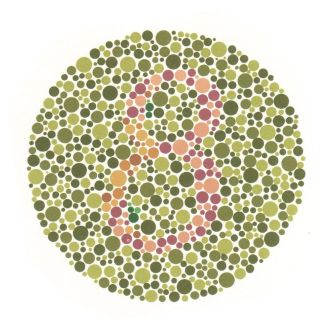
In kindergarten, I used to color people green or brown because that was the closest color crayon I had and I didn't really see the problem. In first grade, I had labels put on my colored pencils for the red, green, and brown. Those dumb maps in geography, social studies, and history textbooks always pissed me off because, while I could tell the different regions were different shades, I couldn't match them up with the key. It causes issues.
But being the precocious introverted child I was, contemplating the way I viewed the world inspired deep thoughts. Were the different names we assigned colors arbitrary? Yes, we all agree that a given object is called by the same color, but how are we to know that the color of an object I see is perceived as the same color by another person? I understood the physics of why different objects appear different colors, but if my consciousness was placed in another body, would colors be the same?
What did this imply about my other senses? Does everyone really perceive salty the same way? What about hot and cold? What about animals with other sense organs like a snake's ability to sense the infrared or a sharks ability to sense electrical impulses, what are we missing out on? What did this imply about the true nature of reality? And I was just in grade school!
Skipping to Buddhist terms, this is what is meant by the "five skandhas are empty." Skandha is translated as heap or aggregate in English. They are the things that make up an object we perceive.
They are:
- Form - the internal or external matter that is defined by the senses. This is different than the Western idea where form exists independent of ourselves with properties for our senses to observe. An object has different forms attached to it for each of our senses.
- Sensation - the raw sensing of an object independent of thought. Sensations fall under the categories of pleasurable, painful, or neutral.
- Cognition - the organization of form through sensation by thought. The mind gets involved and starts to sort the raw sensation.
- Mental formations/Volition - cognition triggers impulses and opinions arrive based on previous experience. Re-cognition
- Discernment/Consciousness - this is awareness without conceptualization. Becoming conscious of something for what it is and is not. Most popularly the dichotomy between "self" and "other" or "good" and "evil."
So my little philosophical crisis really opened the door and waited for this concept years later. Where exactly does color exist? Is it form? Maybe. Pretty much everything, every physical object at least, definitely has some sort of property that we observe visually.
What about sensation? For the most part color is neutral, before cognition at least. We either sense something has color or it doesn't. This would be where my colorblindness changes the game for me, since there is a difference in the way my sensors (eyeballs) receive data.
Cognition is the first step where the mind is involved, our brains as computers organizing the raw data from our eyeballs. Different people have different brains, so color could be interpreted differently in the brain. The physics and the chemistry are all the same here, but there's no way to tell how the brain organizes the info once it's in there.
At the mental formation stage, we now label a perceived and recognized color as what we've agreed it should be called so any damage that could be done by the emptiness of color is done.
Discernment is a problem for the colorblind since our perception of color leaves us with difficulty discerning (see it's right there!) what color we see. In my case the red-through-brown-to-green is an issue as well as the red/purple/blue. While I can tell red is not blue and green is not red, yellow is not purple, those two spectrum blend like white/gray/black. Just as normal people may have trouble telling where gray becomes black, I have trouble telling where purple becomes blue. When side by side, it's easy, but hold up a dark purple shirt towards the blue end of the spectrum, I may not see enough red in it to discern that it's purple.
I always had trouble with what emptiness in a Buddhist context really meant, bringing my own ideas of what the word emptiness means. After looking at it in the context of the five skandhas with this example, I think I have a better grasp on it.
So form is empty because we can't perfectly/directly perceive true reality. But emptiness is form because there is something to perceive. But nor is either of them true because they are creations of the mind, which is the sixth sense.*
It was comforting to find this as a teaching and to know that while I thought so at the time, I hadn't lost my grip on reality before entering high school.
--------------------
*In Buddhism, the mind is considered a sense because the world of our thoughts is just as real as what's "outside" our selves because there is no line separating the two worlds. You either get it or you don't, I don't want to go into explaining it here.
Wednesday, September 15, 2010
If Only I'd Known
I hear a lot of my fellow students complain about test anxiety. For the most part I'd rather take a test than do homework. (which I almost never did anyway) There was a time when I struggled with one particular test and that was what I think was my first taste of living in the moment, or at least being told to.
When I was in second grade learning multiplication tables we had a series of worksheets with all the permutations of 1 x 1 up to 10 x 10; 100 problems total. The kicker was it was timed. What a thing to do to a kid.
So of course, only being like seven and not the most confident of children, I freaked and clammed up. 100 problems is a mind-blowing number for someone so young.
The way my mom told me to deal with it was for me to cover up all of the problems I hadn't done and just focus on the one at hand. Sure I was pretty precocious, but this was still a pretty high concept.
Somehow I got through it, but even today as I write this I can remember very recent examples of me being overwhelmed by a heavy To-do list. Like building my sailboat, I'd spend tons of time planning out what I'd do the next opportunity I had to work on it. I'd get out there and just stare at it. That big project helped me grow a lot in that way. It's still not completely done, but it's been out on the water twice. (maybe in the water is a better description)
While it's been almost two years since then and I haven't been overwhelmed recently, I don't even try to assume I'm over it. My practice has definitely influenced my ability to deal with situations, sure, but it's a hard habit to break.
Just like AA taking one day at a time, learning to take these stressful situations one step at a time is what practice is supposed to help with. The hesitation and fear of entering into situations I must face but can't control will still stick with me no matter what, it's part of being human.
Second grade was a long time ago and that lesson has taken a lot longer to sink in than it took me to memorize multiplication tables, (which I still have to calculate every once in a while) but it's been far more valuable.
When I was in second grade learning multiplication tables we had a series of worksheets with all the permutations of 1 x 1 up to 10 x 10; 100 problems total. The kicker was it was timed. What a thing to do to a kid.
So of course, only being like seven and not the most confident of children, I freaked and clammed up. 100 problems is a mind-blowing number for someone so young.
The way my mom told me to deal with it was for me to cover up all of the problems I hadn't done and just focus on the one at hand. Sure I was pretty precocious, but this was still a pretty high concept.
Somehow I got through it, but even today as I write this I can remember very recent examples of me being overwhelmed by a heavy To-do list. Like building my sailboat, I'd spend tons of time planning out what I'd do the next opportunity I had to work on it. I'd get out there and just stare at it. That big project helped me grow a lot in that way. It's still not completely done, but it's been out on the water twice. (maybe in the water is a better description)
While it's been almost two years since then and I haven't been overwhelmed recently, I don't even try to assume I'm over it. My practice has definitely influenced my ability to deal with situations, sure, but it's a hard habit to break.
Just like AA taking one day at a time, learning to take these stressful situations one step at a time is what practice is supposed to help with. The hesitation and fear of entering into situations I must face but can't control will still stick with me no matter what, it's part of being human.
Second grade was a long time ago and that lesson has taken a lot longer to sink in than it took me to memorize multiplication tables, (which I still have to calculate every once in a while) but it's been far more valuable.
Monday, September 6, 2010
The Guitar Koan
Many years ago, I lived the life a student musician playing bass guitar. My teacher placed a large emphasis on jazz and improvisation and after struggling a little with letting go and just allowing myself to play he asked me an unusual question.
"What is the most important note you will ever play?"
I paused for a second and responded without thinking.
"The one I'm playing."
He was a little taken aback.
"I've asked you this before, haven't I?"
I assured him, that he had not. It just made sense to me. This was before I really knew anything about Buddhism so there was no intellectualization over it, I just kind of knew.
So then he asked me another question.
"What's the least important note you'll ever play?"
"The last note I played, of course," I responded.
"I have to have asked you this before... I'm sure."
"Nope. It just makes sense. You can't unplay a note, and if you're all worried about what to play next, you'll freeze up. You can't ride the groove."
None the less, my improv improved. While I understood, I hadn't implemented the idea. I practiced my scales until my fingers knew what to play when, and I improved.
Now I'm not trying to toot my own horn,(bad musical pun, sorry) but I think it's important to stress that we can have realizations on our own, independent of teachings. I'm sure I'd been told several times the very lesson he'd tried to teach me and I just hadn't gotten it before, but the way he asked it that time was my "stone striking a tile" or whatever.
We can read and listen all we want, but until the spot in our mind is in the right shape for the right shaped piece of information, it won't matter. The purpose of our practice is to exercise the mind, to stretch it out and make it more malleable so that it can receive the Truth when it appears. This is the "immovable mind"* that doesn't get stuck by thoughts with preconceived notions.
While I can't really get behind the idea of koan for the sake of koan, I do understand their purpose when used by the right teacher in the right way. I think the classics are difficult since they've been translated so many times they've lost their cultural relevance and they seem to require an encyclopedic knowledge of zen heritage. But I think the right modern teacher would be able to see in their student the shape of that hole in the mind and be able to give them the right shaped piece to fit it. Well, dharma gates are boundless after all.
I've recently come to the conclusion that zen is the ideology that asks me to make the least changes in myself for practice. The changes and means it asks of me also seem to very straightforward and of obvious benefit. I'm not sure if that's the nature of zen, or if it's just me. As I look back over my life, I've noticed other memories, like this one, that were obvious fingers pointing me in the direction of zen.
--------------------------------------------
* I always found "immovable" tricky, but it's not immovable like the immovable object, it's immovable like the unstoppable force. If the mind is immovable, no thought can come and "move" it or make it stray from its path.
"What is the most important note you will ever play?"
I paused for a second and responded without thinking.
"The one I'm playing."
He was a little taken aback.
"I've asked you this before, haven't I?"
I assured him, that he had not. It just made sense to me. This was before I really knew anything about Buddhism so there was no intellectualization over it, I just kind of knew.
So then he asked me another question.
"What's the least important note you'll ever play?"
"The last note I played, of course," I responded.
"I have to have asked you this before... I'm sure."
"Nope. It just makes sense. You can't unplay a note, and if you're all worried about what to play next, you'll freeze up. You can't ride the groove."
None the less, my improv improved. While I understood, I hadn't implemented the idea. I practiced my scales until my fingers knew what to play when, and I improved.
Now I'm not trying to toot my own horn,(bad musical pun, sorry) but I think it's important to stress that we can have realizations on our own, independent of teachings. I'm sure I'd been told several times the very lesson he'd tried to teach me and I just hadn't gotten it before, but the way he asked it that time was my "stone striking a tile" or whatever.
We can read and listen all we want, but until the spot in our mind is in the right shape for the right shaped piece of information, it won't matter. The purpose of our practice is to exercise the mind, to stretch it out and make it more malleable so that it can receive the Truth when it appears. This is the "immovable mind"* that doesn't get stuck by thoughts with preconceived notions.
While I can't really get behind the idea of koan for the sake of koan, I do understand their purpose when used by the right teacher in the right way. I think the classics are difficult since they've been translated so many times they've lost their cultural relevance and they seem to require an encyclopedic knowledge of zen heritage. But I think the right modern teacher would be able to see in their student the shape of that hole in the mind and be able to give them the right shaped piece to fit it. Well, dharma gates are boundless after all.
I've recently come to the conclusion that zen is the ideology that asks me to make the least changes in myself for practice. The changes and means it asks of me also seem to very straightforward and of obvious benefit. I'm not sure if that's the nature of zen, or if it's just me. As I look back over my life, I've noticed other memories, like this one, that were obvious fingers pointing me in the direction of zen.
--------------------------------------------
* I always found "immovable" tricky, but it's not immovable like the immovable object, it's immovable like the unstoppable force. If the mind is immovable, no thought can come and "move" it or make it stray from its path.
Thursday, August 26, 2010
It's Just a Hair Cut
With this past full moon, I renewed my commitment to myself by cutting my hair. It's something I mentioned in my first post, but now I have the occasion to go into it a little deeper.
First of all, as I said, I did have other reasons. It was also kind of a big deal for me to just cut it all off, so I'll get into that first.
My parents always encouraged my sister and I to make our own decisions growing up and for me, hairstyle was one of those things. I know plenty of people that didn't have that choice, so to them this must all seem a little weird.
I guess one of my first decisions along this line is that I wanted a buzz cut. Not understanding that with blond hair, getting it cut that short would basically make me look like I didn't have any hair at all. It must have been second or third grade and it was a pretty traumatic thing for me. Before I was able to form my own opinion of it, I had a birthday party to go to where the reaction I received was enough to make me regret it. Kids can be so mean. I'm not sure if that's when the seeds of my issues with how it looked began or not, but it had never been that short again until last December.
Another thing about my hair, is that it's not really straight or curly, just annoying. It's never done what I wanted it to. Over the years I'd ended up just about every thing that could be done to control it from plastering it in place to tying it back. It was a battle that I just could not win. I didn't really know how or have the desire to do what it would really take to control it because I didn't think I'd like how it looked.
It's also not entirely blonde. Growing up, I was always told it was "strawberry blond." It tends to change color between blond and light red for no real reason I've been able to isolate. As yet another aspect I had control over, I tried dying it with pretty lousy results.
The biggest irony has to do with me coming to terms with it falling out, though. Baldness runs on both sides of my family, so I had pretty much accepted from an early age that it was not to last. There is a possibility that this has something to do with me wanting it to look good while I still have it, but it's never been an obsession. I'm pretty sure it's stopped where it is, but I wouldn't really mind if I lost more of it.
The other battle I had to fight was with the powers that be, either the authorities at the private schools I attended or later, employers. The mandate was always to get it cut. Two jobs ago, I was desperate and gave in after letting it grow, for the second time, long enough to pull back.
It was once again pretty traumatic, but I got over it eventually. Unfortunately, just cutting it short to a more conservative style didn't make it conform as I'd hoped but that's where it stayed until the last big change.
When I got back into aikido, sweat would soak my hair. The thought occurred that the shorter my hair was, the less of an issue it would be. (I was wrong, I just traded one problem for another) Routine trimming was always put off as long as I could get away with and occasionally, I didn't have the money. If I cut it with clippers, that wouldn't be an issue, I'd just have to make it all the same length.
But the resolve to actually cut it was symbolic considering the commitment I was making. Along the lines of the theme of my first post, I was following the tradition of "cutting my hair" as it's refered to in classical Japanese literature. While less extreme than renouncing the world, I was drawing a line to cross to better my life and follow through on commitments. The biggest way, committing to practice, which I kind of feel began at that point.
So taking the leap, knowing if it looked bad, it would only be a short while before it grew back and I'd be "normal" again, I cut it to 1/4" and it's not too bad. (A couple months ago, I did experiment with 1/8" and that was too short. All the red was cut off and I just didn't like it.)
While I haven't formally taken any vows, to me it's the same thing and being honest with myself is all that really matters. Reminding myself of this once a month keeps that commitment current and present in my life. If there ever happened to be a time I actually went a month without sitting, cutting my hair would be that reminder just as I remind myself what I'm supposed to be doing when I realize my mind is wandering during zazen.
I'm not sure if I've won the battle with my hair or surrendered. I have managed to let go of the style vs. practical aspect of it though. I've heard that once you go utilitarian, you don't go back so this may be an easier commitment to keep than I thought as long as I remember what it's really about.
First of all, as I said, I did have other reasons. It was also kind of a big deal for me to just cut it all off, so I'll get into that first.
My parents always encouraged my sister and I to make our own decisions growing up and for me, hairstyle was one of those things. I know plenty of people that didn't have that choice, so to them this must all seem a little weird.
I guess one of my first decisions along this line is that I wanted a buzz cut. Not understanding that with blond hair, getting it cut that short would basically make me look like I didn't have any hair at all. It must have been second or third grade and it was a pretty traumatic thing for me. Before I was able to form my own opinion of it, I had a birthday party to go to where the reaction I received was enough to make me regret it. Kids can be so mean. I'm not sure if that's when the seeds of my issues with how it looked began or not, but it had never been that short again until last December.
Another thing about my hair, is that it's not really straight or curly, just annoying. It's never done what I wanted it to. Over the years I'd ended up just about every thing that could be done to control it from plastering it in place to tying it back. It was a battle that I just could not win. I didn't really know how or have the desire to do what it would really take to control it because I didn't think I'd like how it looked.
It's also not entirely blonde. Growing up, I was always told it was "strawberry blond." It tends to change color between blond and light red for no real reason I've been able to isolate. As yet another aspect I had control over, I tried dying it with pretty lousy results.
The biggest irony has to do with me coming to terms with it falling out, though. Baldness runs on both sides of my family, so I had pretty much accepted from an early age that it was not to last. There is a possibility that this has something to do with me wanting it to look good while I still have it, but it's never been an obsession. I'm pretty sure it's stopped where it is, but I wouldn't really mind if I lost more of it.
The other battle I had to fight was with the powers that be, either the authorities at the private schools I attended or later, employers. The mandate was always to get it cut. Two jobs ago, I was desperate and gave in after letting it grow, for the second time, long enough to pull back.
It was once again pretty traumatic, but I got over it eventually. Unfortunately, just cutting it short to a more conservative style didn't make it conform as I'd hoped but that's where it stayed until the last big change.
When I got back into aikido, sweat would soak my hair. The thought occurred that the shorter my hair was, the less of an issue it would be. (I was wrong, I just traded one problem for another) Routine trimming was always put off as long as I could get away with and occasionally, I didn't have the money. If I cut it with clippers, that wouldn't be an issue, I'd just have to make it all the same length.
But the resolve to actually cut it was symbolic considering the commitment I was making. Along the lines of the theme of my first post, I was following the tradition of "cutting my hair" as it's refered to in classical Japanese literature. While less extreme than renouncing the world, I was drawing a line to cross to better my life and follow through on commitments. The biggest way, committing to practice, which I kind of feel began at that point.
So taking the leap, knowing if it looked bad, it would only be a short while before it grew back and I'd be "normal" again, I cut it to 1/4" and it's not too bad. (A couple months ago, I did experiment with 1/8" and that was too short. All the red was cut off and I just didn't like it.)
While I haven't formally taken any vows, to me it's the same thing and being honest with myself is all that really matters. Reminding myself of this once a month keeps that commitment current and present in my life. If there ever happened to be a time I actually went a month without sitting, cutting my hair would be that reminder just as I remind myself what I'm supposed to be doing when I realize my mind is wandering during zazen.
I'm not sure if I've won the battle with my hair or surrendered. I have managed to let go of the style vs. practical aspect of it though. I've heard that once you go utilitarian, you don't go back so this may be an easier commitment to keep than I thought as long as I remember what it's really about.
Friday, July 16, 2010
Discipline and New Habits
Since I set this thing up a couple days ago and haven't really done anything with it, I guess my first post should be about discipline. This ties in nicely with my zen practice, culinary school.. and well, a lot of other things in my life.
One of the reasons I'm still in culinary school after four plus years is due to a lack of discipline. I missed a lot of class the first couple years so I had to repeat a lot. I don't want to make excuses anymore and it doesn't really matter anyway, but discipline was pretty much the problem. It was too easy for me to make excuses that I could accept as suitable reasons to either just stay home, drive all the way there and not get out of my car, or just drive around. I've dealt with this for waaaay too long, but I'm fairly confident I've broken that habit. I didn't see it as being lazy, because I really struggled with it. I cared that I wasn't doing what I was supposed to be doing, I was just better at making and accepting my own excuses.
And habit was a big part of it. For many years I've halfheartedly looked for some sort of meditation practice to incorporate into my daily life. I'd tried different moving and sitting forms of meditation, but never really stuck with it. I knew the benefits of such things from my previous experience with aikido. Most of it's benefits were from focusing and staying in the moment, but I had trouble taking those things off the mat into daily life. And of course the reason that was my previous experience is because once I started to lose interest, I gradually stopped going. It had been a hobby, but not yet a habit yet. Every time I was given another chance, I'd psych myself up that it'd be different this time, but I just wasn't able to follow through.
So what's different? What changed that allowed me to make new habits and break the old ones? Now that I think about it, it's not all that obvious. I think the credit rests with resuming Aikido. Last summer, I found a book (not in a store to be bought, but in a box in the woods, but that's another story) called Zen in the Martial Arts. I'd set it aside for a while but read it eventually and it got my interest back up to get back into Aikido. I'd never really lost interest in it entirely, it always kind of stuck with me and colored my worldview in some way, but now I realized I actually had the time to train. The instructor at the dojo I found required a one year commitment, which I did hesitate to commit to (fear isn't really the right word, but in sense it is appropriate).
Over the first few months I had some frustrations, but stuck with it since I was in for the year. Now I've always felt the need to share things I learn with people, mostly as a courtesy to what I've learned, so I've always respected people who teach. But I think the most important lesson I could ever learn was when my teacher told me that there were days she didn't feel like teaching us, but she did because that was the commitment she'd made.
I don't know why that had the effect on me that it did. Of course it was to be expected of her, she's only human; no one could be expected to really want to do anything four days a week with almost no break for years on end no matter how much they enjoyed it. But for some reason, this acknowledgment really struck a chord. I became more aware of the years of effort and dedication to reach that point and that without all of that she would not be in the position to teach us.
As someone who habitually adjusts interests time after time, this sort of dedication was brought into a new light. I couldn't help but see this revelation in the other parts of my life, my teachers at school for example, but not just them: anyone who was any kind of authority on anything had made the conscious decision to commit and follow through with it.
About this same time, I was reading an awesome book, Zen Heart by Ezra Bayda. I credit this book with me actually beginning my practice and will talk about that more some other time. My point, though, is that here was another person who'd dedicated themselves to something that hit home in me somehow. I'd put off actual practice for so long, but this book inspired me in a practical way to make the commitment myself.
Now there were other reasons to do it, and they are all legit, but in an idealistic move I cut my hair about as short as I could tolerate to mark this commitment. I'd needed something concrete that I couldn't ignore and it seemed an appropriate way to mark my commitment to my new life and new practice.
Now whenever I'd scratch my head in wonder about doing what I'm supposed to do, I get that nifty scratchy reminder. Plus, about once a month, I have to renew that commitment by cutting my hair again.
But discipline... yes, back to that. I had started sitting in the evening after my girlfriend went to bed, and that was fine for about a month. It was calming and became a little habitual. I followed what was laid out in Zen Heart for practice until I was able to take a free intro class at the local zen center. I've always been an evening person, but after sitting once early one morning, I learned how sitting can affect my day. I was actually somewhat awake and motivated.
I was fortunate enough to be given a scholarship for a deeper six week intro class to sitting meditation a month later and applied my new perspective on teachers and commitment. Here were two people teaching this class who had dedicated themselves to this life sharing their experiences with me, and on top of that, they had agreed to share it with me without charge. I had to take this seriously to honor this as a gift. It definitely paid off.
I committed myself to get up an hour earlier than I was accustomed to sit for twenty minutes everyday. For anyone who hasn't sat zazen, it's more than you'd think. Just sitting for twenty minutes? How hard can it be? It's pretty tough not just mentally, but physically as well. Discipline is needed to keep from stopping when it starts to hurt or when you get bored. Rather than have a watch in front of me and decide on a time I'd stop. I set a timer and refuse to look at it. I won't move until it goes off so there's no, "eh, that's close enough to twenty minutes.."
Sitting is so simple, and it's a great way to build discipline, among other things. I make the commitment and there's nothing else to do until the time is up. After six months, it has become a habit, and one that spills over into other parts of my life. Gotta go to school? Just go, it's more exciting than just sitting there, and I'm supposed to do it anyway. After enough days not missing: new habit! Don't feel like scooping the litter box, washing dishes, doing laundry? Won't take more than twenty minutes, and my legs won't hurt after doing it.
So the irony of the title of this blog and the title of this post: did I have everything I needed already? Did I have discipline? Well, no... I didn't, not then, but the past is the past. I've learned my lessons, and now, in the present, I do have more discipline than I did. I definitely had the seeds before, otherwise I would have just been lazy without a care of whether or not I did what I was supposed to do. So in a way I did have what I needed already, just not at that present, it was waiting for me in the future to learn my lessons and then I would be ready.
What an ungodly long way to make a point, but before starting this, I didn't have anything at all. So here's to new habits.
One of the reasons I'm still in culinary school after four plus years is due to a lack of discipline. I missed a lot of class the first couple years so I had to repeat a lot. I don't want to make excuses anymore and it doesn't really matter anyway, but discipline was pretty much the problem. It was too easy for me to make excuses that I could accept as suitable reasons to either just stay home, drive all the way there and not get out of my car, or just drive around. I've dealt with this for waaaay too long, but I'm fairly confident I've broken that habit. I didn't see it as being lazy, because I really struggled with it. I cared that I wasn't doing what I was supposed to be doing, I was just better at making and accepting my own excuses.
And habit was a big part of it. For many years I've halfheartedly looked for some sort of meditation practice to incorporate into my daily life. I'd tried different moving and sitting forms of meditation, but never really stuck with it. I knew the benefits of such things from my previous experience with aikido. Most of it's benefits were from focusing and staying in the moment, but I had trouble taking those things off the mat into daily life. And of course the reason that was my previous experience is because once I started to lose interest, I gradually stopped going. It had been a hobby, but not yet a habit yet. Every time I was given another chance, I'd psych myself up that it'd be different this time, but I just wasn't able to follow through.
So what's different? What changed that allowed me to make new habits and break the old ones? Now that I think about it, it's not all that obvious. I think the credit rests with resuming Aikido. Last summer, I found a book (not in a store to be bought, but in a box in the woods, but that's another story) called Zen in the Martial Arts. I'd set it aside for a while but read it eventually and it got my interest back up to get back into Aikido. I'd never really lost interest in it entirely, it always kind of stuck with me and colored my worldview in some way, but now I realized I actually had the time to train. The instructor at the dojo I found required a one year commitment, which I did hesitate to commit to (fear isn't really the right word, but in sense it is appropriate).
Over the first few months I had some frustrations, but stuck with it since I was in for the year. Now I've always felt the need to share things I learn with people, mostly as a courtesy to what I've learned, so I've always respected people who teach. But I think the most important lesson I could ever learn was when my teacher told me that there were days she didn't feel like teaching us, but she did because that was the commitment she'd made.
I don't know why that had the effect on me that it did. Of course it was to be expected of her, she's only human; no one could be expected to really want to do anything four days a week with almost no break for years on end no matter how much they enjoyed it. But for some reason, this acknowledgment really struck a chord. I became more aware of the years of effort and dedication to reach that point and that without all of that she would not be in the position to teach us.
As someone who habitually adjusts interests time after time, this sort of dedication was brought into a new light. I couldn't help but see this revelation in the other parts of my life, my teachers at school for example, but not just them: anyone who was any kind of authority on anything had made the conscious decision to commit and follow through with it.
About this same time, I was reading an awesome book, Zen Heart by Ezra Bayda. I credit this book with me actually beginning my practice and will talk about that more some other time. My point, though, is that here was another person who'd dedicated themselves to something that hit home in me somehow. I'd put off actual practice for so long, but this book inspired me in a practical way to make the commitment myself.
Now there were other reasons to do it, and they are all legit, but in an idealistic move I cut my hair about as short as I could tolerate to mark this commitment. I'd needed something concrete that I couldn't ignore and it seemed an appropriate way to mark my commitment to my new life and new practice.
Now whenever I'd scratch my head in wonder about doing what I'm supposed to do, I get that nifty scratchy reminder. Plus, about once a month, I have to renew that commitment by cutting my hair again.
But discipline... yes, back to that. I had started sitting in the evening after my girlfriend went to bed, and that was fine for about a month. It was calming and became a little habitual. I followed what was laid out in Zen Heart for practice until I was able to take a free intro class at the local zen center. I've always been an evening person, but after sitting once early one morning, I learned how sitting can affect my day. I was actually somewhat awake and motivated.
I was fortunate enough to be given a scholarship for a deeper six week intro class to sitting meditation a month later and applied my new perspective on teachers and commitment. Here were two people teaching this class who had dedicated themselves to this life sharing their experiences with me, and on top of that, they had agreed to share it with me without charge. I had to take this seriously to honor this as a gift. It definitely paid off.
I committed myself to get up an hour earlier than I was accustomed to sit for twenty minutes everyday. For anyone who hasn't sat zazen, it's more than you'd think. Just sitting for twenty minutes? How hard can it be? It's pretty tough not just mentally, but physically as well. Discipline is needed to keep from stopping when it starts to hurt or when you get bored. Rather than have a watch in front of me and decide on a time I'd stop. I set a timer and refuse to look at it. I won't move until it goes off so there's no, "eh, that's close enough to twenty minutes.."
Sitting is so simple, and it's a great way to build discipline, among other things. I make the commitment and there's nothing else to do until the time is up. After six months, it has become a habit, and one that spills over into other parts of my life. Gotta go to school? Just go, it's more exciting than just sitting there, and I'm supposed to do it anyway. After enough days not missing: new habit! Don't feel like scooping the litter box, washing dishes, doing laundry? Won't take more than twenty minutes, and my legs won't hurt after doing it.
So the irony of the title of this blog and the title of this post: did I have everything I needed already? Did I have discipline? Well, no... I didn't, not then, but the past is the past. I've learned my lessons, and now, in the present, I do have more discipline than I did. I definitely had the seeds before, otherwise I would have just been lazy without a care of whether or not I did what I was supposed to do. So in a way I did have what I needed already, just not at that present, it was waiting for me in the future to learn my lessons and then I would be ready.
What an ungodly long way to make a point, but before starting this, I didn't have anything at all. So here's to new habits.
Subscribe to:
Posts (Atom)