Showing posts with label zen. Show all posts

Friday, January 13, 2012

Farmer Zen

(This has been a harder habit to resume than I thought it would be)

So a few months ago, we moved into a house which has a lovely but needy yard. There's a nice plot that was bare of grass I decided would make for a nice vegetable garden. 

Never having had one myself, I used the garden we have at the Zen Center as an example and thereby joined in the humble tradition of the Soto school as a Zen farmer.*

For those of you that don't get the reference, in Japan, the Rinzai school was embraced by the samurai, leaving the Soto tradition to farmers and peasents who had time to patiently sit and wait for enlightenment to come. The samurai on the other hand needed to cut through the matter of life and death "now" since they may face their last opponent in battle at any time.

While I spent quite a lot of time enjoying the outdoors growing up, it's fair to say I did so as a city boy. The most farming I'd done was an herb garden that didn't turn out so well. This is a little larger scale.

I used an axe and a shovel to turn the dense Houston soil and ringed the rough plot with plastic border. It was a lot of work but each moment I did my best to stay with what I was doing and treating it as practice.

By now nearly all the seeds have sprouted and their little leaves are poking through.  It won't be too long before I'll have to thin them out.

For me, this idea of nuturing our practice like growing plants really stikes a chord. My first emotional experience concerning impermanence had to do with a flower. I've also seen the similarities between the momentary effort and patience needed in both practice and planting. My dharma name  (Heavenly Born, Magnificent Bloom) even references the growth and blossoming of my practice.

When we plant a seed, we begin the process, but that's all we're doing. We nuture it by watering and providing sunshine and wait. We can't pull the little sprout out to make it grow faster, we have to wait. The character my teacher has translated as "born" is the same used for "exit" or "protrude" as a sprout comes from the ground. Depending on who you ask, it even originates as a sprout coming forth ( 出).

So we have the sprout which grows and strengthens into a hearty plant over time. Eventually its roots become established and its branches grow strong. When the time is right, a bud forms, and once again we have to wait; there's no forcing a flower to bloom.

Some may see the beautiful opening of the flower as the culmination of practice, for some it may be. But does beauty actually accomplish anything lasting? For nourishment we need fruit so we wait again, and then again for the fruit to ripen.

The fruit bears seeds for the next generation and the dharma continues.

So the seed is hope, looking at it it's hard to discern what it will grow to be. Maintaining the growing plant patiently we only see change over time. The flower rekindles our hope and shows us the precious beauty of our efforts. But the flower's beauty is fleeting and only the fruit of our labor and patience will nourish us and those to come.
---------------------------------

*I've also been revisiting the samurai aspect of my spiritual practice, which rather than confusing and complicated things has actually clarified quite a bit for me right now.

Tuesday, July 12, 2011

When You Hit Bottom, You Bounce

So I'm still struggling to find a job since my last one was so rudely taken from me.  It's not so much that I'm out there everyday getting rejected.  I've actually only made it to one place and they wanted to hire me but didn't have a position available.  The struggle is with myself, and until this morning (more like afternoon) when I was finally pulling myself together for the day, I realized what my big issue was.

I knew I'd been making excuses like I usually do.  I want to say that I've brought this up before but in scanning through my posts, nothing rings a bell.  The first big insight my practice brought me was how easy it is for me to fall for my own excuses, that I just accept them sometimes without even realizing I'm making them up.  I see them as reality and that that's just the way it is.

The problem is, until I find the root of these excuses, it doesn't really do me much good.  Sure I know that I shouldn't be falling for them, but I still do.

What I realized today is that I'm still upset over the loss of my job, even more so than I'd realized.  On a deeper level, the owners of that restaurant kicked me out of my home; not the one where I went to every night and slept, but the one where I spent my days.  My coworkers were in a sense a new family and I'd been cut off from them.  On the surface I'd just seen it as a job and another one would come along to take it's place.  I hadn't dealt with this aspect that lurked so far below.

So I was still angry and holding on to something I know intellectually was passing and impermanent.  It wasn't until today that that understanding went a bit deeper into realizing the impermanence.

What's causing me trouble now is that deep down, I'm scared of that happening again.  I mean, I really hate looking for a job.  I've stayed at places that were really bad for me longer than I should have because it seemed better than looking for a new place.  But this fear comes from an investment in a possible future that I know may not come true.  So instead I hold on to the dream rather than march in to a place and apply.

So many of us do this in so many different situations.  We let our attachment to how we want things (or think they should be) to turn out cripple us from taking the chance.  Looking for jobs, pursuing a romance, making a purchase or any other choice for that matter.

Is there some magic spell we can use to make this anxiety go away, some short cut around the suffering?  No, we just have to accept that this is what life is.  Our practice may help in that if we settle our minds enough, that iron grip on the dream may soften, but just because you have a light grip doesn't make that desire any less sticky.

A little after Christmas I was in a funk, didn't feel myself, slept too late, wasn't motivated to do anything.  It took me a while to realize that I was a little depressed.  It'd been a long time since I'd been to that place so it wasn't easily recognizable.  Once I'd identified it, it lost a lot of it's power, I'd slapped some boundaries on it and defined its previously ambiguous powers.

For a long time I'd been doing really well, riding the wheel to the top.  But once I hit bottom back then, I was able to recognize that it was a wheel and that I wouldn't be there forever.  It had been a nice ride up and the top felt great, but then I was at the bottom and knowing I'd be going back up eventually was kind of what turned it around.

So today I realized the same thing and it had the same effect.  I'm really bummed about not having a job and it should be enough motivation to go out and get one, but something has been in the way.  Now that I've identified it, given it some definition, I know its power's not infinite.  I'm still moving forward and looking up, not down.

It was a long fall down, and I know it's cliche, but before you can bounce back up, you have to hit the bottom.

Friday, June 3, 2011

True Compassion

My aunt has a big rock (it's a novelty rock, probably not even rock but it's big, gray, hard and cold...) that has two sides.  On the top it says "Please turn me over," and on the other "Thank you."

Now it used to bug me that people would keep turning it back over having "gotten the joke" since it obviously preferred to be on the "thank you" side.  But recently I've been thinking about it, wondering if it's not that it prefers a side, but that it enjoys being turned over.

Yes, it's a damn rock.  I know it doesn't have feelings, just what we project on to it.  But I have long felt a sort of animistic connection to many objects for a long time and these are things that I think about.  Animals have preferences that they express in different ways.  Plants express preferences in how they thrive.  Just because all life doesn't experience the world through the same sense gates as we do, doesn't mean that their experience is any less vibrant or real.  As all things are transient and interconnected, who is to say that a rock or any other form of inert existence isn't alive?  It was created, exists in this moment, and will pass into another form eventually.  Where do we draw the line of what life is?

Part of this viewpoint stems from an interesting source.  There's an anime I like a great deal for many reasons called Trigun.  There's an episode where a child version of the hero is having a conversation with the influence of his life and she tells him about how trees are just as active and full of life as we are, using all of their life's force and effort just to grow tall and be green, to reproduce and fulfill their function.

This perspective stuck hard and fast with me.  It also has a great deal on how I view life as a food source, but I promise I'll get around to that post eventually.

My point is, in our limited view, we think we know what's right for others and ourselves.  We think that the commonly held viewpoint of compassion as "a feeling of distress and pity for the suffering or misfortune of another, often including the desire to alleviate it" (dictionary.com) is alleviated through being nice and forgiving and all those other positive things associated with compassion.

The truth of the matter is, sometimes we're wrong.  And we can be very wrong.  Sheltering and pampering can cause someone to become weak and unable to fend for themselves in the real world.  Just as a pet animal can never be released into the wild, the pampered will require that for survival.  Even if they don't they'll have to suffer a great deal in order to regain their instincts.

The world is full of frustrated little dogs treated like children instead of like dogs and a handful of people are making a living reminding their owners of that fact.

This doesn't mean we should kick people to the curb and shut down homeless shelters or food pantries.  This is not a call for an end to altruism, just a call to attempt to understand that what we think someone needs is not necessarily what they need.

I think we all need a certain amount of suffering to get us moving.  If we were perfectly comfortable during zazen it would be harder to stay in the moment.  Without suffering we wouldn't have the need to practice.  Isn't that the whole reason living in the realm of the devas isn't all it's cracked up to be?

Suffering, whether physical, emotional, or intellectual, is the fuel of our practice.  It is the reason we seek to make ourselves better.  Sometimes being compassionate is allowing an individual to suffer just the right amount.  I'm sure I'll revisit this and refine my view, but I doubt it will wander far.


Let us be grateful to experience suffering so that we may seek to go beyond.


Thursday, June 2, 2011

Waking Up from My Dream and Being Angry About It

So after a few short weeks, I woke up from my dream job.  I should remember to never get a job working for owners who either aren't silent or aren't restaurant people.  It doesn't matter how great your crew is or how wonderfully they're led by the management, if the owners won't let go their ego in favor of the success of the business, it's doomed to fail. 

So here I find myself with two paths.

1 - Be pissed off, and for good reason.  This really was a dream opportunity.  I was coming into a restaurant that needed my particular skills.  It was a delightful atmosphere, very casual yet mature enough that things still got done.  The management was sincerely invested in every employees success and saw the greater picture.  After just long enough to start making plans for the future, like committing to cook three meals a day for my sangha for 45 days, around my work schedule, the chef that doesn't even work there told me my next scheduled day, I wouldn't be on the kitchen schedule. 

Not "we have to let you go, sorry," but, some lame story about how business is slow and they want to keep me around because I'm a quality employee but due to loyalty to other (less skilled or motivated) employees who don't know they should have asked for a raise because they deserve it, that I should talk to the front of the house manager about serving or bartending.  Other gems concerning the owners and a whole mess of trouble arose after that, but that's what I had to deal with then.

== OR ==

2. I see it for how it's benefited me.  I did make some new friends and had some fun in a cool environment.  I learned some new skills and recipes since I'd never worked as a prep cook before.  My interest in returning to the kitchen was renewed, whereas before I was dreading it as an obstacle to my graduation.  I also rekindled that spark from my first job of "the people in charge are irresponsible and/or stupid, I can do this better. What's stopping me?"  After taking it easy for so long I feel that assertiveness again.  This time I can taste the ability to actually help a restaurant prosper and grow, not just survive.

It also held time for me in a way.  I was able to get at least 3 weeks into the practice period before really having to get another job.  I could have gotten a different one that wouldn't have afforded me that option.  Being tenzo for Ango is more valuable to me in experience than any job I've had so far.  I really am behaving and working as a chef, not like a chef, but as a chef.  I'm planning daily menus once a week, putting together shopping lists and purchasing ingredients.  I'm also learning to delegate responsibility to make sure things get done when I'm not around, and have had to deal with the consequences of it not getting done.  I'm actually cooking breakfast, lunch and dinner Saturday through Thursday with the exception of two dinners.  I've had to pay attention to dietary needs as I haven't before since what I cook is essentially the diet for 8+ people for nearly two months.

So take a guess at which path I've chosen.

Both actually, and it's been an interesting experience.  Being angry is just as legitimately a Buddhist experience as sending love to my tormentors and wishing all beings happiness.  The Ninth Grave Precept is a prohibition against harboring ill will, not ever feeling it.  Allowing myself to feel what I feel is in accord with the teachings.  I can feel angry all I want as long as I'm mindful of why I'm angry.  Harboring ill will is holding on to and giving it shelter.  Once the emotion has done what  it needs, it should be let go.

The anger still comes up about the whole thing, as well as the joy in what may most likely happen to the whole operation.  But that dream I had about what my future path would hold in that life really is just that, a dream.  There was never any guarantee that that's how my life would turn out, and it definitely wouldn't be everything I imagined, it never is.

So now I return to the moment, take the bad as bad and the good as good.  I have other hopes of employment lined up, ones that may be infinitely better and that wouldn't have been available to me in the same way two months ago.

How can anyone argue with that?

Wednesday, June 1, 2011

Right Here Between Two Worlds

Halfway into this third week of Ango, my fellow participants and I have made some interesting observations of the atmosphere of practice now that the excitement of receiving so many guests has passed.

While this is my first practice period, it is the third for Houston Zen Center and others have made some thought inspiring comments about how it feels.  Having only done two week long retreats and a handful of half day sittings, this hasn't quite had the same feeling.

With sesshin, you're there.  You're there to practice and that's it: sitting, eating, and working.  It's a full immersion experience for the week.  For most you only leave to sleep.  It's very different than daily life in that you don't have the distractions or responsibilities of the outside world to interfere with... well it's called a "retreat" for a reason.

In our daily life, practice is something we sometimes only do on the cushion.  It's easy to forget about it as the distractions of every day life get in the way.  Yeah, that's not how it's supposed to be, and even though I pride myself on how my practice is especially my everyday life, none of us is perfect and we all forget.

What's been interesting about the practice period is that it has us situated between those two extremes.  We're all participating in different ways, but there's always someone there practicing away.  There's the intensity of sesshin, but with each of us venturing out back into the world to conduct our affairs independently then returning in various capacities.


Normally a handful of us show up in the morning and get everything going for a little more than an hours worth of activities and then the place is cold until the evening when it happens again.  Four hours on Saturday we have activities but each time we have to get back in the mood.  During this practice period, someone has been there to keep the place warm by feeding the practice fire.

It's been an interesting experience in the kitchen for me as this practice blends my usual daily life with life at the Zen Center.  I spend a lot of time planning menus and preparing shopping lists if not shopping myself.  One of my first comments to my teacher upon completing my first sesshin was of how different it seemed from everyday life, to run away to Tassajara was especially exotic after living a taste of what it could be like for a week.  It troubled me how easy it was to assume the culture of monastic life and how much I would miss "normal life" if I spent a summer there.  She told me that when you're there, that is normal life, which didn't exactly ease my concerns.
But nearly a month into living a life between the two, the "practice" life has become my daily life.  I don't feel I have had to, or become, a different person to live it.  There's an extreme nature to monastic life that, while I can see the appeal, it still doesn't seem like the life for me.  In the Ox Herding series, "returning to the marketplace" is the last step and refers to coming returning to mundane life to live as an example of enlightened activity.  The tradition is that temples were up in mountains so returning to the market place was synonymous with leaving the monastery.  I've always said that I never want to leave the marketplace.  I'm not interested in an enlightenment that involves going somewhere else.  Even if it takes longer, I want it right here.

I really feel that 45 days of this with an actual sesshin at the end will be very different and I'm looking forward to seeing what happens.  The regime of sesshin helped my provide my own structure to life afterwards but wore off fairly quickly.  Maybe a little over a long time will build better habits and I'll continue to live right here, between the two worlds of mundane life and the monastic.

Friday, April 22, 2011

Shaving Ice, One Hopper At a Time

My new job entails a lot of prep work, which I enjoy a great deal.  When you're a server there's side work to do that can be similar, but the biggest difference is that it's done on the side, as in while you're still waiting tables. 

In the kitchen, your attention is almost entirely on just what's in front of you.  In the dining room it's a little different. Waiting tables requires a lot more multitasking so the monotonous aspects of the side work require you to always keep your mind on your tables while you're doing it, forcing you to split your attention.  How un-Zen is that?

Now don't get me wrong, the way I did side work, at least in attitude, was altered by my practice, but it was still difficult to throw myself into cutting lemon wedges if I had to keep track of whether or not table 24's entree is up and if it was timed right that they're just finishing their appetizer so that I can use the same tray to bus those plates that I'm bringing the new food on.

In the kitchen there's a list.  It's always waiting, but nothing demands your attention more than the one item on that list you're doing now.  Everything else will be there for you when you're ready for it.  There's still a sense of urgency since you are getting paid by the hour and it's all got to be done before you can leave, but it's still just patiently awaiting its turn.

This is something I'd missed, fondly remembering assembling the collapsed boxes for chicken strips while watching the South Texas Sunset out a window at another job I held long ago.

I find myself peeling and deveining a lot of shrimp.  Today they were cooked first so I had to peel off their dorsal side and remove all the guts inside.  I noticed that as soon as I let my mind wander, what was supposed to go in the trash was going in with the shrimp, oops.  A split second was all that it took for me to make a mistake.

The restaurant I work at now serves oysters on the half shell, a lot of them.  So in anticipation for tonight's business I was asked to shave ice for their plating.  There's a sno-cone machine in the wonderfully brisk 32 degree walk in cooler where I stood for the better part of an hour cramming about a half gallon of ice at a time into the hopper and pushing down the frozen plunger.

I knew about how much I was going to need, but the cold was getting to me and my thinking mind kept going for ways of making the process go faster.  There was nothing I could do though as the hopper was only so big and it had to be loaded by hand each time.

Dishwasher and prep cook are usually the two entry level positions in a kitchen for a good reason.  The results of the work is usually taken for granted and almost always boring.  The skill level is relatively low and so is the pay.

But as I was grinding away, I wasn't reminded of the tenzo dutifully drying mushrooms in the hot sun because someone had to.  I was reminded instead of Huineng pounding away at rice for years until he realized the Truth.  I embraced it as an opportunity for enlightenment, not as just something that needed to get done.

After the first few minutes my arm and shoulder were getting tired from trying to push the plunger down from above my shoulders, so I relaxed and let my Aikido earn its keep by connecting with it and dropping my weight, letting the heaviness of my body do the work instead of my shoulder and upper arm.  This of course is connected with the breath and as I exhaled with each stroke, I saw each load as a breath and a moment in my life to be present in and enjoy.  So I did.

Every now and then that impatience popped up, prompted by the numbing cold in my fingers and diminishing amount left to do.  But I took a breath and enjoyed it, not only for the sake of enlightenment, but just because I could.

Tuesday, March 29, 2011

Every Moment is Your Life

My last post got a comment that I wanted to respond to with a long explanation that, as I began writing it, I realized, "hey! this is my blog. I can just write a post in response."  To those of you who read but don't comment, oh what you could be missing out on. So I promised to do so and here it is:

The comment, or portion of the comment that spoke to me was this:
But in reality, look at today's world and the competition facing each person.... how many individuals would afford the time to truly enjoy his/her personal space? I would say not many. People who can afford to go leisure travelling, or birds watching or moon viewing are usually retired people or people who are very rich. They have taken care of the major financial part of their life and they can afford the time and money in hobbies making.
This has theme has been popping up in my life recently in so many aspects of my study.  The first place it really struck me was on the last page of chapter 4 of Uchiyama Roshi's How to Cook Your Life, a commentary on the Tenzo Kyokun.  The chapter's title is "Everything You Encounter Is Your Life." He says,

I wonder if there are not many people today who suffer because they feel themselves to be poor or misfortunate, or who have an inferiority complex because they think they belong to the lowest level of society.  To me, this is foolish, since they are only thinking in terms of their being but one member of society.  Living out the true Self means to put away these ideas of upper or lower, success or failure, and to learn to see that everything we encounter is our life, our true Self.  The expression "I alone am revered in heaven and earth," though generally referring to Shakyamuni Buddha, is not limited to him. It applies to every one of us.
... There is no need to compare ourselves with those around us, nor to put ourselves into awkward and painful situations.  Rather it is vital for us to take the utmost care of that world in which we live out our total Self.  This is the fundamental spirit running through the Tenzo Kyokun.    (emphasis mine)
 This concept is unbelievably profound yet we hear it all the time, "now is all that matters!", "stay in the moment!","there is no past or future."  But how many of us live that idea, really live it?

This seems to be the ox that I'm searching for right now, I've got a whole herd of them and they've all escaped, but this one in particular is on my list.  I've seen its tracks in that I see the practicality of holding this viewpoint as a lifestyle, maybe I've even glanced it as truth among the distractions of life a few times.  It has yet to present itself fully, though, so I continue to seek it.

I have a lot of things to distract me right now, and many of them are unpleasant.  But as I go about my day doing chores and running errands, there are times that I feel at peace and a little happy.  Every day is full of more and more of them. Walking to the car, I know there are problems waiting for me in the future, but that's okay.  When they become that moment, they will be dealt with, for now just walk to the car.  The sky is beautifully blue, the breeze is pleasant on my face, my belly is full and I'm easily walking on my own free will.  How can I compare these with other pleasures, especially those of they who have more money than I?

And isn't it constantly pointed out to us that money can't buy happiness?  How many of the rich and powerful are miserable every moment despite their wealth and leisure time?

Every moment is your life, not someone else's.  Every moment is charged with all of existence, there is nothing outside of it.  So help me take this advice and do your best to live it as well.

Thank you cicidabee, for reading and commenting. I appreciate the inspiration.

Monday, March 21, 2011

The Floating World: an Anchor Would Be Nice

... Living only for the moment, turning our full attention to the pleasures of the moon, the snow, the cherry blossoms and the maple leaves; singing songs, drinking wine, diverting ourselves in just floating, floating; ... refusing to be disheartened, like a gourd floating along with the river current: this is what we call the floating world...
                                                     - Asai Ryōi, from Ukiyo monogatari   

I lifted this quote from wikipedia concerning the philosophical aesthetic of  the Ukiyo-e, which as a style, has long appealed to me.  It sounds so very Bohemian and so desirable, like an endless vacation.

Lacking the daily structure of a job for almost a year now, I can say it's not all it's cracked up to be.

The flip side of this carefree coin is one of constant unknown which is fine if you don't plan on being a productive member of society.  Sure you can benefit others if the opportunity arises, but living in the moment sometimes means making commitments and pre-planning.

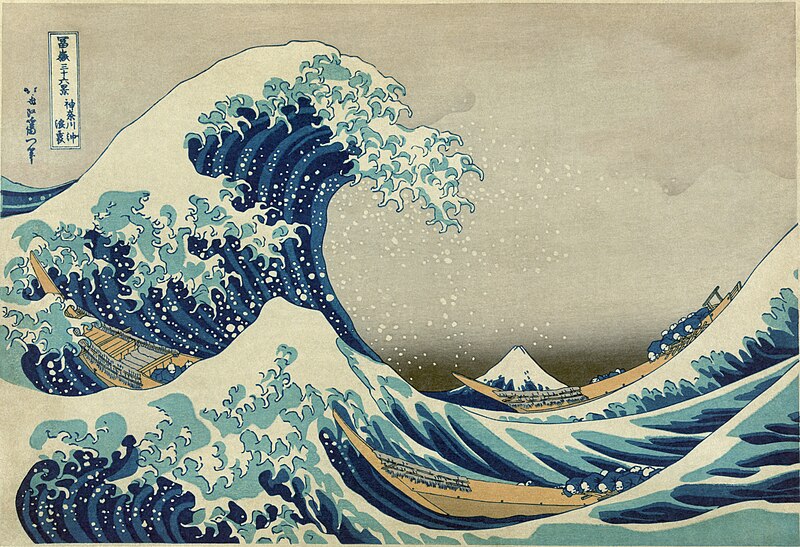
Great Wave at Kanagawa*
Living in this floating world in reality, is being set adrift.  As a sailor, I can tell you that being adrift is about the slowest you can move and still be terrified that you're either unavoidably going to hit something or conversely never hit anything again.  Even when the helm responds, conditions may be such that that desire of direction is ineffectual in practice.


As I am currently seeking employment, I can't make future commitments and jot them down on a calender as I have no idea what my future holds.  At this time my role as tenzo has many requests for my services coming into view and as paying the bills rates higher on my priorities, I'm not able to make the commitment now even if I have the time when it is requested.

This is both frustrating and disappointing as I not only take my role and responsibility seriously, my pleasure and generosity associated with it come from a very deep and sincere place inside of me.  The sangha needs me and while things can happen without me, the greater burden placed on others will essentially be my fault if I'm not able to answer the call.

In my continuing exploration of non-duality, I see this relating to the polarity of form and emptiness.  I see lack of form, and thus a great deal of emptiness in my days.  I still get things done, even if it's not always what I should be doing, but moments come and go regardless.  To restore balance, I need more form as my current situation is unsettling, like tumbling in the dark, or to return to the above metaphor: floating adrift.

I see the need to recognize both form and emptiness as the world doesn't end if a form falls apart, but right now the world is difficult to start without forms.

Floating is nice, but it's good to have an anchor or two.

-------------------------------------------------
*This iconic Hokusai print, borrowed from Wikimedia Commons, is an ukiyo-e image depicting boats of fishermen struggling against the sea.  It shows a wonderful example of when it is appropriate to be flexible.  These fishermen are brave and skillful, as they must push through the breakers to reach their fishing grounds.  But there is a difference between being flexible and flaccid.  Without effort, they would capsize and be crushed.

Monday, March 14, 2011

Words, What's the Point? or Stupid Non-Duality...

I'm sure it's just a stage, like those one passes through when dealing with grief.  If that's the case, I have no choice but to fully throw myself into it and wallow in the frustrating paradox that is coming to grips with non-duality.

A big issue with Zen teachings is their stereotypical "illogical" nature made famous by the promotions of D.T. Suzuki.*  I had pretty much wrapped my mind around the emptiness of words and how we shouldn't rely on them when practical experience is a better teacher, but having experienced directly a handful of things that, in the light (or should I say "darkness") of non-duality, are inexpressible in words; my heart has not been so pliant.

Remembering a post by Shundo at The Ino's Blog concerning the use of jargon at San Francisco's City Center, inspiration struck.

We're always told that only a realized teacher can confirm "enlightenment" experiences and I'd more or less just taken this on faith.  They see that you get "it" enough, so yeah, the experience is valid.  But when it comes to koans not having fixed answers, I just didn't understand how this could work.

Just as a visitor wouldn't really know what the "doshi door" was without experiencing it, we can't really know the true nature of anything without experiencing it.  People can give descriptions, even show you pictures, but until you actually experience it, your only reference of the door is secondary sources, shallow imitations of the real deal.

In having misunderstands/disagreements about the meaning of terms, or even whole and fundamental teachings, with people online and in person, I do and have realized that we really are talking about the same thing, but that our concepts of what the words we use mean, are different.

I've long felt that people are who they are because they are comprised of their experiences, built up as individuals by a lifetime of events and influences.**  All of these situations have determined how we see the world and how we define the things around us.

Words, being abstract representations of these experiences, only have meaning because we have all agreed up their meaning, this is how language develops.  Someone says, "This is a ball, from now on, you see one of these and call it a ball, I'll know what you're talking about." Everyone agrees and we have one idea of what a ball is.  Something else shaped the same way, the same size, color and everything pops up and we have a dilemma. Do we agree that this new object is a ball, too, or do we call it something else?  So now we have criteria for what a ball is.***

But abstract ideas add a new dimension to this because we can't point to them.  (I could write a whole book on this phenomena, but then I'd have wasted my time because that's what Zen and the Art of Motorcycle Maintenance is about.)  I'm very fond of the idea of words as fingers pointing to the truth so this is a metaphor that pops up for me a lot.

Each moment of our existence is different from those around us, so the rules that we assign to our existence are different.  Most notably the difference between right and wrong is a good example.  Given an individual's upbringing the appropriate way to interact with authority figures can be drastically different, giving them a different sense of right and wrong.  I could go deeper into this, but I hope you get where I'm going.

When it comes to our experience of reality, this causes trouble until we have an experience in which we glimpse its true nature.  The words we use to communicate our experience to a teacher are direct references, and if we're lucky our words will point at the same thing our teacher's understanding looks towards.  Until we have that experience ourselves (like seeing the doshi door) our fingers just point at other fingers and our experience isn't direct.

(I hope you're still with me.)

Words, unfortunately will always just point, so all I can do is point and hope you understand, not what I'm pointing to, but that this sign I'm holding up is understood to even point.  So I'll just keep pointing, not expecting anyone to understand or even read this blog just like I did at the very beginning. 

Maybe the mountains are becoming mountains again, they sure seem to be trying.

-----------------------------------------------------


 *I've more or less given up on his works as a practical reference as I don't think he really knew what he was talking about.  Sure in a talking "about" way, he did.  He was talking circles around the truth, but never pointing directly at it.  Scholarly analysis just doesn't do Zen justice and as a practitioner, this was one of the first gates I passed through finally after ten years of intellectual study.

**Later Buddhism gave me a framework for expressing this. Since these are the heaps/aggregates/skandhas, that are fundamentally empty, the "face we had before our parents were born" is like the blank canvas or empty vessel that all of this goes into.  This is not however, a belief of environment over genetics determining who we are since genetics have evolved as a response to the environment of our ancestors ("before our parents were born") as well as forms of life and even the planet, then stars, making the history of the entire universe influential in who we are in every moment of our lives.  Thus, that "face" is the self independent of phenomena, the absolute primordial inexpressible action/actor.

***When I took an intro to philosophy class in college, one of our discussions was an epistemological argument concerning whether or not it was possible to distinguish whether one of two objects, having identical properties, was removed a second time from a box or if it was the one left behind the first time.  Hating hypothetical questions for their assumptions, I questioned whether one of the identical properties was that it was really one object existing simultaneously in two places.  This blew the lid off the conversation, effectively ruining it, but it's a hypothesis that's stuck with me. Eventually, I mean to post about this. (if you have a comment about this, just encourage me to write the post and we'll discuss it then)

Tuesday, March 8, 2011

"Shut Up!"

Living with the themes of non-duality has made writing very difficult for me right now.  This was the major theme of our retreat two weeks ago and its effect has been interesting.  A lot of the things I had queued up to write about don't mean what they used to in this new light and I now struggle to put into words what I really mean.

Almost two months ago, I started to dive into the Sandokai, well it's English translation actually, titled "The Harmony of Difference and Equality."  It's a poem about non-duality by eighth century teacher Shitou Xiqian (or Sekito Kisen in Japanese).  He wrote it around the time that the fallout from the division created when the Fifth Patriarch in China chose the uneducated Hui-neng as his successor leading to the difference of Northern and Southern Zen.  If you're not familiar with this story, it's in the Platform Sutra, check it out.

The Sandokai is an invitation to reconcile the differences between the Northern and Southern Schools at a time where there was a lot of dualistic talk distinguishing the validity of different perspectives on the same truth, the buddhadharma.

I'm making my way through Branching Streams Flow in the Dark, a collection of Suzuki Roshi's talks on this important poem in the Soto tradition.  When examined through my "practice eye" so much of it makes sense, but its meaning goes beyond words and even if I use my own words to describe my own understanding, it doesn't seem adequate to me, and I know exactly what I'm trying to say so you should be able to sense my frustration.

Instead of banging my head against the wall, I'll express a sentiment that Suzuki Roshi felt Sekito was trying to express and tell everyone, including myself to just "shut up!"
I am following Sekito's poem line by line, but actually it is necessary to read it straight through from beginning to end.  If you talk about it piece by piece it doesn't make much sense.  Sekito is very strict in his conclusion, very strict.  You cannot escape from him.  You cannot say anything or else you will feel his big stick.  In his time the Zen world was too noisy, so he became very angry.  "Shut up!" is what he said, actually.  So I shouldn't talk so long.  Maybe it's been too long.  Excuse me.
 So, I'm not giving up, I still have things to say.  But I think Suzuki Roshi's observation about eighth century China applies to the world today.  The Zen world is very noisy today.  Rather than losing my temper and becoming angry, I am trying to become comfortable with this issue.  But it's still a little frustrating.

I see a lot of similarity between the things I have to say in observing divisive talk between different Buddhist factions online, as well as other religious discussions.  I see the dharma in each, why can't they just be alright knowing they're just on different paths up the same mountain?

Wednesday, March 2, 2011

So Much Stuff: Post-retreat Thoughts from the Tenzo

Sunday I came back from the culmination of two weeks worth of effort for a five day retreat led by Tenshin Reb Anderson, Roshi.  This was different from Rohatsu Sesshin in that we were hosted by a another Zen Center in a rural area outside Houston.  They provided us with housing, a building to use as a zendo, and a wonderful kitchen.  We were just required to bring all the stuff necessary to make those facilities usable for our needs.

We basically brought everything from our own zendo that wasn't nailed down (with the exception of the altar and our statuary, using a wonderful Vairochana Buddha instead), nearly everything in our kitchen but the sink, as well as all of our personal stuff that we'd need throughout the five days.

Apparently it's official since everyone called me such and my place card in the zendo read "tenzo." I still don't quite feel I deserve the title tenzo, since I still had a great deal of help from both my teacher, Gaelyn, both before and during the retreat, as well as Dale Kent, co-author of Tassajara Dinners and Desserts, former tenzo himself with loads of experience in the kitchen at Tassajara.  Both were a tremendous help, but everyone was intent on giving me all of the credit.

So I mentioned two weeks worth of effort. The food at retreats doesn't just appear and a great deal of planning and purchasing happened before the retreat. 

A lot. 

One shopping list reads "38 large carrots, 40 onions, 7 doz eggs, 10# cornmeal.." going on for three pages and being just one of a couple lists.

As we were loading up the cars for the 45 minute drive will produce, dry and canned goods, and dairy along with pots, serving dishes, knives and utensils, it seemed overwhelming.  I would essentially be responsible for making sure that initially 26 and, as the weekend arrived, 45 people were fed three times a day for five days.  The sheer amount of stuff required for this task was daunting.

One thing Reb brought up a few times was how much stuff we brought with us to make this retreat happen and what a great feat this was, but as the week progressed, as tenzo I saw it as a metaphor.

We had brought with us a whole lot of stuff.  Essentially the only things we had were what we brought with us.  As the week progressed in the kitchen, as each meal came up, we examined the ingredients, processed them, then let them be with compassion, offering them to the community.  Slowly the piles of stuff got smaller and our burden was lessened. 

Yes we still had a lot of stuff in the form of implements and leftovers, but there was definitely less.  Upon returning there would be more stuff again, but we would remember what it was like to have so much and to let some of it go.

All of us at the retreat, brought with us a lot of emotional baggage.  Just like the food in the kitchen, as we sat, we examined our thoughts, processed them then let them be with compassion.  At the end of the week, there was still stuff floating around in our heads and hearts with lots more of it waiting for us upon returning, but we would know what it was like to let so much of it go and not only that it was possible, but how wonderful it could be.

Friday, February 11, 2011

Television, DVRs, and Getting What We Want

During dokusan this week , this idea came to mind about not always getting what we want. 

Now, I'm a grown up so while I may not live it all the time, I do know that I can't always get what I want.  Yes, it's a seductive fantasy, but realistically it has its drawbacks.

In trying to communicate my comfort with this position on the matter, I equated it as like watching tv with no commercials.

Traditionally, you turn on the tv and flip through the channels looking for something to watch.  If you don't find something that interests you, too bad, deal with it or turn it off.  This is life: you're born, you wander through life and you either deal with it, or (as the comparison implies) you off yourself.

There are programs we don't like and commercials for things we'll never buy.  These are like the hard times in life.

The good times are our favorite programs, we just can't get enough of them.  Sometimes we even tape them so we can watch them again and again.

The widespread use of the DVR has changed all of that.  In our household, we watch our favorite shows off of the DVR so much that we don't even know when they normally come on.  Even though we have dozens upon dozens of channels, after scanning the few we normally watch and finding nothing we go straight to the DVR to catch up on what we've missed.  While we watch, we have the ability to fast forward through commercials, skipping over the obnoxious part of watching television, the part that pays the bills so that our favorite shows can even be made!

We can search to find when our shows will be on so that we can record that new series we've been hearing so much about.  Some shows and movies are even available instantly on demand.

In our constant struggle with handling life as it is now, our entertainment has led to this.  How many of us would like so much for life to be this way: summoning our favorite parts of life and skipping through all of the bad.

This is the fertile field of context where my thought sprouted.

There are two types of commercials, those that sell products and those that promote other shows.  Skipping through the commercials, we lose out on both. 

Yes, we've all seen that one commercial a million times and blow it off each time, thinking "who would want that?" or in the case of car commercials, "who can afford that?!"  So we become cynical about these types of commercials and ignore them.  But every once in a while something does appeal: a sale here, a new product there.  Look what we would have missed out on if we hadn't seen the commercial?

There are commercials of the other type, promoting shows, that just anger me in how mindless the product they are promoting is, reinforcing this feeling, "that show's still on? who the hell enjoys that?"  I'd love to be rid of these.  But what about that commercial for that show I've not heard of?  "Hey, that sounds appealing. I should watch that."  Once again, I would have missed out on what may become my new favorite show.

This is what life is like.  There are things we want to watch and sometimes the things we need to watch are mixed in with what we don't want.  Sometimes life can even go the other way and get unbalanced like suffering through the Super Bowl just to see that commercial everyone will be talking about on Monday.

Some good examples of how this shows up in life... hmm.   Well how many of us are happy and in good relationships (or even happy and single)?  This can't possible be the first relationship you've been in, or at least the first person you've liked.  How many times have you been rejected?  But now look at you, would you have found that perfect someone if you were still stuck in that one sided abusive relationship with that narcissist you dated a few years back? (If they're reading this with you, just smile and nod, exclaiming "of course not!" if you're a little confused at this point.  Trust me, that's the right answer)

Or what about that job that didn't work out?  Nobody wants a crumby job where they perform so poorly out of displeasure that they get fired.  Even getting rejected from several job interviews has it's upside in that you have the opportunity to improve.

I myself, have dealt with these things.  So many unpleasant occurrences that have shaped me into the well rounded and grounded person that I am today.  I have so many interests that I wouldn't have even dreamt of if one thing or another had gone the way I wanted them to.

Now's the point where you expect me to tell you to get rid of the DVR and stop wanting things to go your way, right?

Well that's the funny thing about Buddhism.  The DVR, and desires, are alright if we remain aware of what exactly they are and what we may be missing out on by indulging them.  We have every right to want things, even those that we don't need.  When they cause trouble is when we begin to feel entitled to them, when they get in the way of enjoying what we have now.  If it helps to consider what others have to do without, then go for it.  Maybe give up using the DVR so much and suffer through a few commercials?  It couldn't hurt, might even learn something.  But neither of these things are asked of you.

So many Buddhists talk about extinction of desire or craving, but that's not truly possible.  Even that itself is a desire.  What the truth of the matter is, the way to satisfaction and shaking the grip suffering has on your life is the extinction of the hold desire has on you. 

Take control back.

I find irony in this coming holiday.  Society tells us to give candy to those society tells to be skinny.  With this in mind, is it alright to desire another piece of chocolate? Yes.  Accept it as natural, but don't think the world revolves around you eating or not eating it.  If you eat it, eat it; if you don't move on.

This is Zen, accept the obstacle, make a decision and move on.  This is the key to happiness.

Thursday, February 3, 2011

De-Sire Is Not a River in Egypt

There's a lot of talk about desire, wanting, and detachment in Buddhism that's often misunderstood.  Desire is considered the cause of suffering so a lot of people think we're supposed to get rid of it.

But what makes it so bad?  We're not ascetics so getting rid of it is a little extreme.

I've recently been finding a lot of interesting dualities, the kind that exist as opposite sides of the same coin.  Desire and denial are two that have popped up.  Desire is usually associated with wanting, you give in to it and end up wallowing in excess.  Give in to denial and you go the other way, living with nothing.


In the whole mix of mindfulness and living in the moment, denial and desire are very much related. 

When we desire something, it's usually because we're unhappy with the way things are.  We want something we don't have, or want something to be different in the past, present or future.  In this way, desire is a denial of what really is.  We deny the reality of the moment.


Getting rid of desire is like taking medicine to control the symptoms rather than the disease.  Sometimes a headache is just a headache, just as wanting that flashy phone or juicy cheeseburger is just a want.  But other times a headache is something more.


Families or loved ones are often considered one such "headache" by some.  They find distress in loving their families when being told to give up attachments and desires.


In this situation what is it that desire denies?  Our desire to care and protect those we love is a good thing, giving us reason to be balanced and productive in life.  Any denial involved in doing so is healthy, usually considered compassionate. 


Where desire causes problems is when they're not met.  All desires are are preconceived notions of what we want life to be.  Just like all preconceived ideas, they're usually not founded in reality.  Even if we get what we believe our desires to be fulfilled, they almost never match up with what expected and even if they do, the thrill dissipates over time.


This is the type of desire we're warned against.  It'll still happen, there's no way to get rid of it.  We're hardwired to want more because our bodies can never be permanently satisfied.


This is where attachment comes into play.  If we get hooked on the dissatisfaction with not having out desires met, we continue to deny reality.  This is the root of suffering.  Having desires is okay, it's not letting go of them when they don't measure up.


Taking families as an example, no one's family is perfect.  The one's that are happy with their families are the ones that accept this.  Letting go of that standard prevents dissatisfaction.


Standards are relative and mostly arbitrary so it's not the desires that cause the issues so much as our unwillingness to realize the nature of our standards and holding on to them.


Reality is as it is, our actions have brought us to where we are.  Denying reality puts us at odds with truth, making us unhappy.


Only through being aware of this gives us the perspective to correct our views and behaviors.

Monday, December 20, 2010

Are You Ready for the Truth?

One of the first things we were taught in the Intro to Zen Meditation class at the Zen Center was the two types of Zen meditation.  I've found "types" to not be a very accurate word to use, when we're letting whatever happens happen, the two can arise on their own, sometimes at the same time. I guess "effects" may be more appropriate, but I don't make the rules...

But anyway, these two types are insight and calming/relaxing.  The first involves the dissolution of delusions, allowing us to see reality for what it really is.  This may be about the interconnectedness of everything, the reality of the causes of suffering, or the impermanence of everything; which together are referred to as the Three Marks of Existence in Buddhism.

However, without a calm, relaxed mind we won't be to experience this insight.  Calmness and relaxation also allow us to remain upright physically, mentally and spiritually.

So these ideas hung around me for the better part of a year, occasionally surfacing with some meaning but usually not much impact.

A few months ago, I participated in a retreat and one of the themes that arose during the dharma talk was this twofold aspect of zazen and things clicked a little more for me.

If we don't relax, we may still experience the insight, but it can frighten or upset us.  The Truth can be cold and uncaring if we're not ready to see it even if it is for our own good.  I think that this potential is greatest observed in those who pursue spiritual awakening with psychotropic experimentation or any sort of short cut "enlightenment now" methods.  The same things are experienced but without the spiritual discipline provided by long training the event can be damaging.  The Truth can be heavy; you don't just walk into a gym and try to bench press the heaviest weight in the room with no training.  The Truth can crush you in the same way.

So in my head, this all made sense.  Even in experience some light was shone.  But only recently have I been able to observe how I've experienced how all of this ties together.

Our delusions are like toys, as Uchiyama Roshi put it.  They distract us from reality.  Practicing zazen allows us to loosen our grip on those toys so that when we see them for what they really are, we'll be comfortable letting go.  We invest a lot in our delusions, sometimes thinking them as the only things we really have.  Like babies, we hold on to them with all of our might.  Sometimes Life comes along and wrenches them out of our hands and we panic and cry out in fear.

Sometimes though, babies let go of their toys and they fall aside on their own either because something new comes along or they relax.  In the same way we deal with our delusions.  The best of the two options being when we relax and realize we don't need that particular delusion any more.  For me these usually happen in "ah-ha" moments.  Something clicks inside me and I realize the truth behind my thought.  Realizing the truth that a particular koan points to is a good example.  Everything just falls into place and makes sense.

Other times my reaction is more emotional than a eureka moment.  The realization can cause my heart to break a little and I tear up.  These experiences are on the border of readiness between overdue and completely comfortable, and being unprepared for such deep insight.

Staring into the dark, the light may shine on small truths we've already felt with our hands; knowing their identities before the light goes on.  Other times it shines on things that have brushed against our leg.  Our other senses have given us ideas about its identity, but still unsure, the sudden light frightens us.  The truly frightening is when all the lights go on to reveal to us things unimagined and thus thoroughly not understood staring us in the face with all its glory.

So with zazen, we feel around in the dark and our experiences are flashes of light illuminating the truth.  Sometimes we see and understand, sometimes we don't.  Other times it catches us off guard, but no matter what, if we're serious about finding the real Truth we must relax our grip and let go of our fantasies and delusions about what joys and horrors are out there so that we will acknowledge it when it shows itself.  It's always there just waiting for us to enter the endless Dharma gates.

Wednesday, December 15, 2010

Acceptance is More Than Just Unconditional Passivism

So I've heard the argument against Buddhism stated that we just accept the negative and look the other way.  This is usually said when others are being critical of a lack of social action or political action from Buddhists.

Personally, I am not yet at a place in my life where I have the resources for such work, but I can't speak for others.  Over the past several months there's been a lot of discussion over the appropriateness of "socially engaged" Buddhism.  While I don't see just being Buddhist as a reason to engage in organized societal change, I do agree that Buddhism does encourage us to be a positive influence in the world.

But that's not what this post is about.  Instead this is partially a response to that initial criticism, but mostly it's a clarification of what the concept of "acceptance" in Zen really means.

A lot of people hear "acceptance" and they think just sitting back and letting whatever happen happen.  This is not always a live-and-let-die attitude.  Sometimes acceptance is about dealing with a situation that presents itself.

Sometimes these situations are pleasant and easy to accept.  At those times we don't have to do anything.

But sometimes we're faced with a difficult struggle.  Critics would assume we just throw our hands up and accept the bad news.  And we can.  If that's all we want from life.

The appropriate action is to face the truth, question if we have the ability to affect change and make it happen if we can.

One way this has manifested in history is Zen's influence on the samurai class in feudal Japan and its legacy of bushido and martial arts.

The Rinzai Zen master Takuan Soho counseled two of the most famous swordsmen in Japanese history, Miyamoto Musashi and Yagyu Munenori.  Records of his teachings can be found in The Unfettered Mind, a collection of instructions Takuan sent as letters.  Zen teachings on how to be a better swordsman.

Sounds pretty contradictory, doesn't it?  Buddhism is portrayed as peace loving pacifism, but Zen at least is not so black and white.

If someone threatens your life, you have the right to defend yourself with up to and including lethal force.  Yes, there are repercussions for such actions and you may possibly go to prison, but if someone intends to kill you, they may have already killed or will kill others in the future so just letting them cut you down doesn't mean you're just giving your life out of "compassion" by not taking theirs.  It's doubtful they'll feel remorse and change their ways.  In the moment, you don't have time to make that decision though. The best you can do is avoid being presented with such situations.

He says that we don't even have a gap the width of a hair between intention and action, but other times our actions do not require such immediate action.

A good example that I'm faced with right now is that of finding a job.  You always turn in the application, they say they'll call you and then you wait.  Sometimes you feel like you're waiting too long.  You're faced with the dilemma of did you fall through the cracks or was their answer "no." 

You could just accept the latter, or you could accept the situation as a challenge and find out for sure.  In the moment, all you have is a simple decision: follow up or let it go.  There should be no worry or speculation, just find out.  The first is what others think acceptance means, the second is what it means in the context of Zen.

This reminds me of one of my favorite quotes concerning situations like this attributed to Shantideva, an 8th century Indian Buddhist scholar and author of Bodhicaryavatara, or Guide to a Bodhisattva's Way of Life:
If you can solve your problem, then what is the need of worrying? If you cannot solve it, then what is the use of worrying?
 It's good advice. Just do it or don't, but either way let it go and move on.

Saturday, December 11, 2010

You Can Only Change Yourself

Day one of our 2nd (annual? with fingers crossed) seminar with Shihan Hiroshi Ikeda and this is one of the things I'm walking away with: "you can't change others, only yourself."

Ikeda Sensei's specialty is internal work and he's known for this even outside of Aikido circles.  Internal techniques involve externally unobservable changes made in the dynamic between two people and Aikido would not work without it.  In my experience, it has mostly to do with the power of the mind expressed through an intention, usually referred to esoterically as ki or ch'i.  From the outside it looks fake, but only after you've been on the receiving end yourself does the magic become real.  Many of us were lucky enough to be exposed to this last year but it was so new we had no idea what was really going on.  With a year's time to work with it, the things he says and demonstrates make more sense quicker.

Like everything else in Aikido, this message functions on many levels even if it was only presented as a guideline fundamental for physical technique.  In context, he was telling us when faced by a physically stronger opponent, we can't move them.  The only way to exert our will is for us to move ourselves, and if we're successful in making a connection, they will follow.

Out of the context of physical confrontation, taken into everyday life, this is a powerful lesson.  In Zen we see it pop up quite often.  We can only hope to control ourselves, if we're able to control anything.

My Aikido teacher reminds us often that the first step in self defense is defending us from ourselves, echoing the same idea.

In Zen, we accept that the world around us exists, but that it is devoid of meaning until we fill it up with our ideas.  Most of this is unconsciously done with pieces of our lifetime's worth of experiences fit together like a puzzle.  The purpose of Zen practice is to tame the unconscious so that we can choose how we define the world around us.  By changing our outlook, we change ourselves and thus the world not only for ourselves, but in a smaller way for everyone else who feels the consequences of our actions.

The Mahayana perspective is that of saving all sentient beings along with ourselves, but we have to straighten out our own mess first.  By doing this we make the world a better place, doing just what we can is all we can do.  In its outward form, Aikido is about fixing the mess of someone wanting to hurt us.  On a subtler level it's about resolving the conflict with another by acknowledging we are not the omniscient and omnipotent center of the universe; we must humble ourselves to get what we want.  In reality this manifests in both Zen and Aikido (as philosophy) in the fact that if we let the ego run untamed, we will always be in conflict with the universe.  To change the external, we must start with what have and change the internal.

And just as in both Aikido and Zen, the work is never done.  Every new situation will suggest excuses to us, "he told me this," "I got stuck in traffic," "I didn't know," "but she started it.." Changing the self requires constant effort because the self is not static, each moment is completely new.  Sure, we have habits and patterns, but that is all they are; there will always be anomalies.  And just like genetic mutations, if left unchecked, they will spiral out of control until we don't recognize our own behavior any more.

So instead of letting blame slide, don't let yourself be the victim.  Change what you can: yourself.

Wednesday, December 8, 2010

The Form and Emptiness of the Teacher/Student Relationship

According to tradition, the "proper" way to become a student of Zen after finding a teacher is to present him or her with a small gift and formally request to be his or her student (I guess "traditionally" it would have only been "him" and "his," but whatever).  Being a sucker for traditions, I couldn't allow myself to proceed any further in my studies, especially as I approach closer to receiving the Precepts, without doing this.  I don't know how far this practice will take me, but I don't want to break with tradition.

So I did this yesterday.

During dokusan, I presented my teacher a small memento of a powerful experience that I had had many years ago and asked to be her student.  I was of course accepted, since this is essentially a formality and I had already been her student for some time.

There is no way of me knowing how common this practice is in my sangha, let alone in the world today.  I consider this practice to be more a cultural thing; a holdover from different times when becoming a student was an absolute thing where the request was akin to signing a lease to live in a monastery.  In today's world people wear many hats and dropping in on a teacher every once in a while is more the accepted practice.  Here in the United States, as Zen is still finding its identity, our American practices do not expect such a formal request.  For many people, even just the need for a teacher isn't all that strong. I wouldn't have known about this formality if I hadn't read about it in some books.  It doesn't really matter to me whether any of my fellow students have done this at all, but I felt it was right for me.

So what's the big deal?  I was already a student, why make the request and present a gift?

The relationship between student and teacher is just as empty as anything else.  This doesn't mean that it doesn't matter, but that it's like a bucket labeled "teacher/student relationship."  It has no fundamental definition.  Until we put our own thoughts and feelings as to what it means to us, the bucket remains empty.  Until now, my bucket held the idea that here was a person dedicated to spreading the Dharma and saving all beings living a vow to help anyone asking for it.  We were fellow travelers on the road and I was being offered advice.

To me the gift represents the idea that this request is more than just a verbal thing.  It shows a higher level of commitment. Time and effort were spent pondering it and I am giving something of myself to this relationship.  The formal request is just as symbolic.  To surrender to the idea of needing help to walk the path is humbling.  To make this request to a teacher is to both admit your own humility but to also acknowledge your worthiness of pursuing the path.  Until we can do both things we will never quite arrive at our destination.

With this formal acceptance, my bucket holds some new ideas.  My actions signal my commitment to the path and that I don't intend to just wander off.  Because of this, a new intimacy exists.  While I still consider my teacher as a fellow traveler, I now fully acknowledge her as one who has "gone before"* and I will wholeheartedly follow her lead.  More than just pointing her finger to the truth for me to see, I have given her my hand so that she may point my own finger. 

Our origins are different so in places the route will be completely different.  Where it's the same, the road may have changed a little since she passed through. While my exact destination may differ, the direction is the same and I am one step closer to getting there.

------------------------------------------------------
*a rough translation of sensei

Monday, December 6, 2010

Incomparable Acceptance

As I wait for the lessons sown during last week's Rohatsu Sesshin to sprout and poke through in my mind, I'll visit an important lesson from a couple months ago: while they can have their purposes, comparisons are empty.

A good place this pops up is during warm up stretching for Aikido.  We all have different body types and flexibility so my teacher always reminds us to not compare ourselves with others; just focus on stretching.  It does no good to compare whether we can touch our hands to our toes, elbows to the floor or whatever.  Our effort is to stretch and that is its own benefit.

Usually she points out that if we push ourselves, that stretching that far will never be that painful again.  Each time it will just get easier.  Ideally this is true if we do it everyday, because our muscles will have stretched, resetting their maximum length.  I find this false though, it's not enough to not compare ourselves with others, we shouldn't even compare ourselves with ourselves.  Frequently I'll have days when I'm tighter than I have been before and I can't quite reach as far as I could last time.  If I get caught up in thinking I should be able to go further, I could hurt myself.

Applied to my Zen practice, this came up in dokusan.  I was mildly annoyed that after a wonderful progression of improvement in my sitting, I was having a spell of difficulty focusing during zazen.  Doing the natural thing, I questioned it and examined it to discover what this meant.  The obvious intellectual conclusion is that I just have to let the results be the results with acceptance and continue my effort.

In my mind, I "know" that the path is what matters and not the goal; that it's about the effort I expend not the results.  This situation made me realize the truth of this, but I have yet to actualize it.

It makes no sense to compare the practice of this moment with that of a past moment when each exists completely independently of each other.  There's no way to take two moments, set them side by side and critically compare them any more than its possible to take two persons' minds and compare their activities side by side.  Any former perception of past results is altered by time; it's no longer real like the present.

We practice zazen to cultivate many things.  The Six Paramitas do a good job of summing them up: generosity, ethics, patience, enthusiastic perseverance, concentration, and wisdom.  Acceptance and discipline are a couple more that fit in there, too.

We plant the various seeds with our daily life in the soil of our very being. Our practice is the sunlight and nourishment that encourages their growth.  We can't pull on the sprouts to make them grow faster.  Neither can we neglect one in favor of another.

When we struggle with our practice, these virtues are starving. The extra effort we put forth is needed to wring out the sustenance they need; it doesn't just pour easily from the watering can.

Sure we can kick back and take it easy, the virtues might grow on their own but they're just as likely to shrivel up and die.  Besides, what's the point of cultivating a harvest if we don't even care enough to make it is as bounteous as possible?

So accept life's ups and downs, do your best in the moment because that is all that matters.

Sunday, November 28, 2010

Ecstacy and the Mediocrity Principle

There is a principle in science that says that no place in the universe is any different than any other place.  This "Mediocrity Principle" has had powerful implications through the centuries.  Its weightiest application is that Earth is not special in giving rise to and sustaining life; that because the Earth isn't special life can exist elsewhere.

Furthermore this principle can be extended to the "Temporal Mediocrity Principle," stating that no time is any different than any other.  For those of us trying to live in the moment, this should be somewhat comforting; science backing up our beliefs.

Where this can get tricky is that the implication of each space or moment being no different is no more or less special than any other.  Any sort of special experiences such as enlightenment, satori, kensho, or even ecstasy exist in a moment and that moment, no matter how mind blowing it is, is still just a moment. So when something "special" happens we may get hung up on the circumstances of its causes or effects.

Since these experiences, being special, are not all the time happenings,what good does this serve us?  Why does it matter that every moment is the same as every other moment, and is it really even true?  Mediocrity isn't even all that cool.  It's mediocre.

Obviously we experience moments to be different, otherwise this would just be common sense.  So what makes this so, what's the variable?  We are what makes each moment different than others.  Each moment arrives waiting for us to assign values to it.  Not every moment is a blank canvas, sometimes life throws us some pretty tricky situations, but we still determine what it means to us.

Usually this process is unconscious.  Situations arise and our experiences tell us what to think about them.  Zen training helps us take control of that though.

We develop our minds to take charge over the unconscious mind.  We tame the unconscious so that it can no longer drag us and our emotions and thoughts all over.  Using the five skandhas as windows to examine the emptiness of each moment, we can use our conscious thoughts to fill them up with whatever emotions we want.  Left to its own devices, the unconscious will play the game according to the ego's rules.  Because the ego's deluded, this usually leads to suffering.  By taking control, we change the rules and the outcome.

A lot of times, people, especially spiritual gurus, harp on this.  The problem is that it has become buzz words that are left unexplained unless you pay whatever sum they ask to find out how.  But it's nothing special.  Buddhists have been spreading this idea for more than 2500 years.  The book I've been reading, Just Use This Mind, is built upon it with "change your mind, change your life" as its slogan.

As I prepare for Rohatsu Sesshin, I have an exciting and unbelievably boring adventure ahead of me.  I know it will be challenging, but in surrendering my freedom, I'm freeing myself to experience something special.  If I sit with escape on my mind, I'll miss out on what I can experience each moment.

There will be boredom, there may be powerful experiences.  I don't know, and won't know until each moment arrives.  All I have to do is keep these principles at hand.

Sunday, November 21, 2010

Epic Fail

Now that I've got the posting of my interview taken care of, I've got a lot of catching up to do.  Last weekend we had guests from several places come to stay at the Zen Center for a priest ordination.  They had to eat, so I answered the call to prepare a few meals for guests and residents.

In the almost twenty years that I've been cooking, half of that professionally, I've never cut myself with knife anything more than a scratch.  So within fifteen minutes of prepping for breakfast I dragged my knife across the tip of my finger, cutting deep. Of all the places and times for it to happen, it happened at the Zen Center, where cooking is emphasized as mindful practice. I'm professionally trained in various knife skills and even I managed to cut myself just slicing apples.  I wouldn't necessarily call it hubris, I was still being careful, but my mind drifted.  This served as a painful reminder that it doesn't matter how experienced you are, you always have to pay attention to what you're doing.

I disrespected my knife by not giving it my full attention and it bit me.

Knowing that the painful lessons are the ones that we're most likely to remember, I think (hope) that I learned my lesson.  A few days later as I was watching it heal, I wondered if it would leave a scar.  I've never been one for battle scars from the kitchen as many line cooks are, but I thought a permanent mark might be fitting as a reminder to remain present while cooking.

The thought of scarred fingers took me a few digits over to a mark on my index finger about an inch long and an eighth of an inch wide with three pairs of dots along side.  This is an old scar from my childhood that resulted from some poorly thought out creativity.

I used to make all kinds of things from the cardboard that came in my dad's laundered work shirts.  On this occasion I was trying to poke a hole in a piece with one blade of a pair of scissors.  I was successful in making the hole, but on the other side was the gap between my index and middle finger.  The gap wasn't wide enough for the blade to miss slicing my finger.

At first I thought it was just a scratch... until I moved the cardboard away.  There was so much blood!  Before my mind could make sense of it, there was blood all over the desk where I was sitting.  I'm not sure if it actually hurt as much as I thought it did at the time, but seeing that much of my own blood incited panic.

This happened at the school where my mom was teaching at the time, on the day before school started.  I know that she was in a meeting, but I don't remember all of the details between seeing the blood and sitting in the trauma room at the ER other than the pain and terror.  By the time the doctors came in to stitch me up, it'd worn off.  I don't remember if it still hurt, but I'd calmed down and was hoping it wasn't going to require stitches.

The cut was deep.  When the bleeding slowed and they cleaned the wound I could see through the layers of skin into the meat.  The doctors decided to skip injecting the local anesthetic and just poured it right in, saving me the added trauma before the sutures. 

Without the pain as a distraction, it had become a learning experience for me.  How often do you get closer than front row seats to a finger getting stitched back together?  It was interesting and made for a great story on the first day of school back from summer vacation.  Plus, on the way home from the hospital all I could think about was the sight of some poor second grader showing up for the first day of class to a dried pool of blood on his desk and floor.  (I was told later that it had been cleaned up shortly after we'd left for the hospital.)

It's weird how life teaches us lessons.  We're always supposed to learn from our mistakes and sometimes we do, but other times the point just doesn't get driven home enough.  Sometime life uses erosion and slowly etches the lesson in over time, but other times it cuts right to the chase and splits us right open.

I'm not sure if my recent cut will leave a scar, so its lesson may come and go.  What I do know is that I've sure watched where my fingers are before poking a blade through an object over the last twenty some years.