Friday, September 17, 2010

Marubashi and The Spirit of Ikkyo

In my first post, I brought up my issues with getting to class. I'd either give up before I'd even started or just stopped in my car and sat in the parking lot. While I'm confident that this is no longer a problem, it is still an issue as I discovered the last two mornings I had class.

Getting up isn't an issue anymore. I may be tired, but I'm committed to my sitting practice. However, I'd get about halfway to school and that familiar feeling would come crawling up from deep inside.

I don't think that "fear" is the right word, but I can't really think of how to put it. The devil that sits on my shoulder has gotten smaller and quieter, but it's still telling me to go back home and go to sleep or just do anything but suffer through a loss of freedom for seven hours. That fear of losing my freedom is still there.

Since this is a "battle" I'm waging with myself, this post will be more about my Aikido practice. While it is pretty easy for me to separate the physical differences between my Zen and Aikido, their impact on my day to day life are like my right and left hands. I don't need both of them, they each kind of do the same things. But when they work together, I'm twice as equipped to deal with life.

First, two terms or concepts to define: ikkyo and marubashi.

Ikkyo
literally means "first lesson." It happens to be a specific physical technique, but it has a deeper meaning that Aikido's founder Morihei Ueshiba, or O-Sensei as he is referred to, stressed as the secret to Aikido.

The technique of ikkyo involves entering into the attack (irimi) with precise timing (de-ai), distance (ma-ai), and energy (zanshin) to catch your attacker at the most advantageous moment to take their balance. This first lesson becomes the foundation for other techniques as they all require irimi for success and build upon it with added concepts. Without irimi, there is no Aikido.

Marubashi is a borrowed term from the Yagyu Style of swordsmanship and is translated as "bridge of life." Aikido is heavily based on the sword arts and employs several or their concepts. While straight blocking a weapons attack may be possible, getting out of the way is always the best option in case the block is ineffective.* Sometimes getting out of the way isn't possible and we must face an attack head on, as if facing an enemy on a narrow log bridge high over a river. There is no left, right, back or even hesitation as the sword comes charging at you.

My teacher's teacher and devoted personal student of O-Sensei, Mitsugi Saotome explains this in one of his books, Aikido and the Harmony of Nature:
Choosing life is death. The only path is the enemy's path. There must be no separation, but an exchange of time and space with the spirit of moving into the very heart of the enemy. This is the spirit of irimi (entering). When you extend your spirit into the future, the present is neutralized. Negative becomes positive; positive becomes negative. Past becomes future, and future becomes now. Only by abandoning attachment to time and space, attachment to life, will you attain the true freedom of choosing death. The bridge and life are the same. Heaven and hell are now, infinity is now. Choosing death is life. This must be practiced and become instinctive.
Alright, so this sounds all good and martial and all, but how does it relate to my issue above? Well, first of all, a lot of that probably sounds pretty familiar from a Zen perspective: opposites switching, past becomes future, infinity is now, must be practiced and become instinctive... Is it any wonder the warrior class of feudal Japan embraced Zen?

This is a guide as to how to live a good life, not how to take them. Our greatest enemy and the one that we face every moment of every day, is our self, our ego. It flaunts our desires in front of us like a carrot on a stick to lead us around. The death that we choose is the death of the ego. Choosing life for the ego is great initially but just around the corner are the karmic rewards of death, suffering.

My issue above is that of not wanting to give up the freedom of indulging the ego and its desires. I have to go to class. My ego is trying to convince me that I have a choice out of self preservation. Saotome Sensei also writes:
Giving up attachment to life and death is the refusal to be controlled by fear, the refusal to be controlled by the selfish ego, which clouds the spiritual eye. With no thought of escape, whether the threat is pain, discomfort, or death, you must continue in the Way with all of your might, not with the purposes of ego in your heart, but leaving your fate in the hands of God.
As I was driving along to school, traveling along the road of life, my ego met me holding the sword of freedom on the the bridge of life, my marubashi.

I met my ego with the Spirit of Ikkyo and abandoned my thoughts of escape and the threat of pain and discomfort (didn't have to worry about death, thank goodness).

I continued on my Way and cut down my ego.

It's far from dead, though, it is strong and persistent. The fingers of my Zen teachers and that of my Aikido teacher are only able to point me in the right direction, they can't take me there, but they are both pointing at the same thing. The ego is not going anywhere anytime soon so I'm greatful to have them all at hand to help me learn to deal with it.

------------------------------------------------------
*There is no blocking in Aikido, btw. Instead attacks are met with receptive force and their energy is blended to a favorable direction by the attacked to diffuse the situation. I may go into that another time because it too has many daily life applications

Thursday, September 16, 2010

Colorblindness and the Illusion of Reality

When I decided to start this blog, I made a list of things to write about and saved them on my computer to have topics to use during dry spells. This one in particular has been staring me in the face for a while.

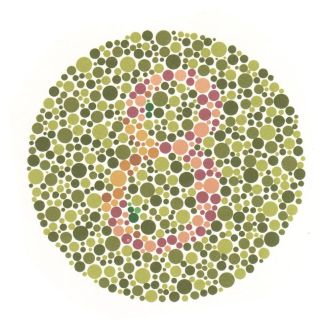
I happen to be colorblind; red-green specifically. Here are some good facts about colorblindness so I won't have to go into it. (I do get asked "what color is this?" way too often when I admit my handicap)

A couple of the facts:
#01 99% of all colorblind people are not really color blind but color deficient; the term color blindness is misleading.

#06 Strongly colorblind people might only be able to tell about 20 hues apart from each other, with normal color vision this number raises to more than 100 different hues.

#20 Colorblind people feel handicapped in everyday life, and almost nobody recognizes this.

#29 Some people get rejected from a job assignment because of their color vision deficiency.

#32 Red-green color blindness doesn’t mean that you are only mixing up red and green colors, but the whole color spectrum can cause you problems.

#41 The most often used types of color blindness tests are: pseudoisochromatic plates, arrangement test, and the anomaloscope.

Here's a Ishihara Color Blindness Test Plate that's just one of a few ways to test for colorblindness. I can just barely make out the number that's in there. As if someone turned the contrast way down.
In kindergarten, I used to color people green or brown because that was the closest color crayon I had and I didn't really see the problem. In first grade, I had labels put on my colored pencils for the red, green, and brown. Those dumb maps in geography, social studies, and history textbooks always pissed me off because, while I could tell the different regions were different shades, I couldn't match them up with the key. It causes issues.

But being the precocious introverted child I was, contemplating the way I viewed the world inspired deep thoughts. Were the different names we assigned colors arbitrary? Yes, we all agree that a given object is called by the same color, but how are we to know that the color of an object I see is perceived as the same color by another person? I understood the physics of why different objects appear different colors, but if my consciousness was placed in another body, would colors be the same?

What did this imply about my other senses? Does everyone really perceive salty the same way? What about hot and cold? What about animals with other sense organs like a snake's ability to sense the infrared or a sharks ability to sense electrical impulses, what are we missing out on? What did this imply about the true nature of reality? And I was just in grade school!

Skipping to Buddhist terms, this is what is meant by the "five skandhas are empty." Skandha is translated as heap or aggregate in English. They are the things that make up an object we perceive.
They are:
  • Form - the internal or external matter that is defined by the senses. This is different than the Western idea where form exists independent of ourselves with properties for our senses to observe. An object has different forms attached to it for each of our senses.
  • Sensation - the raw sensing of an object independent of thought. Sensations fall under the categories of pleasurable, painful, or neutral.
  • Cognition - the organization of form through sensation by thought. The mind gets involved and starts to sort the raw sensation.
  • Mental formations/Volition - cognition triggers impulses and opinions arrive based on previous experience. Re-cognition
  • Discernment/Consciousness - this is awareness without conceptualization. Becoming conscious of something for what it is and is not. Most popularly the dichotomy between "self" and "other" or "good" and "evil."
These are "empty" in the Buddhist sense because they are all dependent upon the perspective of the individual. They have no independent permanent properties, no permanent "substance" to fill them. It's not they don't exist, we just can't perceive their "perfect" nature because our view is incomplete. Uchiyama Roshi uses the example of two people observing a cup from different perspectives, the light will be different and each will see different angles of the same cup, so neither can tell the true nature of the cup.

So my little philosophical crisis really opened the door and waited for this concept years later. Where exactly does color exist? Is it form? Maybe. Pretty much everything, every physical object at least, definitely has some sort of property that we observe visually.

What about sensation? For the most part color is neutral, before cognition at least. We either sense something has color or it doesn't. This would be where my colorblindness changes the game for me, since there is a difference in the way my sensors (eyeballs) receive data.

Cognition is the first step where the mind is involved, our brains as computers organizing the raw data from our eyeballs. Different people have different brains, so color could be interpreted differently in the brain. The physics and the chemistry are all the same here, but there's no way to tell how the brain organizes the info once it's in there.

At the mental formation stage, we now label a perceived and recognized color as what we've agreed it should be called so any damage that could be done by the emptiness of color is done.

Discernment is a problem for the colorblind since our perception of color leaves us with difficulty discerning (see it's right there!) what color we see. In my case the red-through-brown-to-green is an issue as well as the red/purple/blue. While I can tell red is not blue and green is not red, yellow is not purple, those two spectrum blend like white/gray/black. Just as normal people may have trouble telling where gray becomes black, I have trouble telling where purple becomes blue. When side by side, it's easy, but hold up a dark purple shirt towards the blue end of the spectrum, I may not see enough red in it to discern that it's purple.

I always had trouble with what emptiness in a Buddhist context really meant, bringing my own ideas of what the word emptiness means. After looking at it in the context of the five skandhas with this example, I think I have a better grasp on it.

So form is empty because we can't perfectly/directly perceive true reality. But emptiness is form because there is something to perceive. But nor is either of them true because they are creations of the mind, which is the sixth sense.*

It was comforting to find this as a teaching and to know that while I thought so at the time, I hadn't lost my grip on reality before entering high school.

--------------------
*In Buddhism, the mind is considered a sense because the world of our thoughts is just as real as what's "outside" our selves because there is no line separating the two worlds. You either get it or you don't, I don't want to go into explaining it here.

Wednesday, September 15, 2010

If Only I'd Known

I hear a lot of my fellow students complain about test anxiety. For the most part I'd rather take a test than do homework. (which I almost never did anyway) There was a time when I struggled with one particular test and that was what I think was my first taste of living in the moment, or at least being told to.

When I was in second grade learning multiplication tables we had a series of worksheets with all the permutations of 1 x 1 up to 10 x 10; 100 problems total. The kicker was it was timed. What a thing to do to a kid.

So of course, only being like seven and not the most confident of children, I freaked and clammed up. 100 problems is a mind-blowing number for someone so young.

The way my mom told me to deal with it was for me to cover up all of the problems I hadn't done and just focus on the one at hand. Sure I was pretty precocious, but this was still a pretty high concept.

Somehow I got through it, but even today as I write this I can remember very recent examples of me being overwhelmed by a heavy To-do list. Like building my sailboat, I'd spend tons of time planning out what I'd do the next opportunity I had to work on it. I'd get out there and just stare at it. That big project helped me grow a lot in that way. It's still not completely done, but it's been out on the water twice. (maybe in the water is a better description)

While it's been almost two years since then and I haven't been overwhelmed recently, I don't even try to assume I'm over it. My practice has definitely influenced my ability to deal with situations, sure, but it's a hard habit to break.

Just like AA taking one day at a time, learning to take these stressful situations one step at a time is what practice is supposed to help with. The hesitation and fear of entering into situations I must face but can't control will still stick with me no matter what, it's part of being human.

Second grade was a long time ago and that lesson has taken a lot longer to sink in than it took me to memorize multiplication tables, (which I still have to calculate every once in a while) but it's been far more valuable.

Tuesday, September 14, 2010

Re-(Not)Thinking Sitting

I've noticed a few changes in my practice recently, like what goes on while I'm sitting. This nice post got me to re-examine my practice so I'd like to go over it a little bit so I'll at least have something to look back on.

Pretty much from the beginning, when I'd sat, my mind was a little like a TV screen with my thoughts-of-not-thinking taking up most of the screen and my thinking thoughts scrolling across the bottom like a news ticker. Sometimes I'd get caught with what was passing by on the bottom, but then come back to what I was supposed to be watching.

This seemed like a pretty good setup. I wasn't intentionally blocking my thoughts, just being aware they were there and letting them go by. It wasn't an intentional contrivance, it would just present itself that way. Guess I watch too much TV.

Other times I would find things a little differently. My breath would be like the waves on the beach, in and out without effort or stopping. Thoughts would wash up like crabs or seaweed and soil my pristine beach. Instead of tracking all over the sand to throw them back, I would just let the out-breath wash them back out to sea. Sometimes it would take a few waves, but they'd leave eventually.

These aren't really visualizations, though. They're closer to metaphors of just how it works. But with both of them thoughts were pretty concrete, the longer I practiced, the more concrete the thoughts became. It got to the point where coming back to the present was as solid a feeling as waking from sleep to find my dreams dissolved into nothing.

Recently, though my thoughts have become sneakier. They've learned how to ride the waves and interject like commercials. Like enjoying the clear blue sky only to realize you're contriving shapes from the clouds. They're quieter as they slip in and sit there like they're supposed to belong.

While I intellectually understand all the lessons I should have about this: not judging my practice, not getting frustrated by change, new opportunities, blah, blah... it's still a little annoying.

Honestly, while I've been sitting regularly for between three and seven months (depending on your definition of regular) if I were to judge my practice, I'd say I was doing better when I'd just begun. The only thing that's gotten better is my flexibility, improving my comfort level. Whether that view is tainted by the passage of time or not, I don't know. But I have stuck with it and it's most definitely a habit.

With these new developments, one new perspective has illuminated itself. In my comment of the post linked to above, I stated my issue with letting the time pass during zazen. A few days after making that comment, I realized what I was really acknowledging: impatience.

This was a little bit of a shock, since I pride myself on being pretty patient. I know it's not always true, but still... I can pretty much tell out of habit when about twenty minutes has passed and since I've started trying to sit for thirty at home, when that's passed. I think sub-consciously I'm just telling myself, "good effort, that's enough zazen but you got finished too fast and now we have to wait until time's up," like I'm taking a standardized test or something.

Surrendering to a timer is still surrendering in the way surrendering is giving up this way. While I freed my mind from the responsibility of deciding when enough was enough, I wasn't addressing the problem of being impatient.

So now when I sit, I have to be mindful of this. Come back to what my body is telling me after I've decided enough is enough, because enough is never enough. All I've accomplished is the ability is to sit for twenty minutes, not to sit in the moment moment after moment. In Opening the Hand of Thought, Uchiyama Roshi urges us to "sit for ten years, then for ten more years, then another ten years." But I sit for twenty minutes, then twenty more, and another twenty when I should just be sitting.

Wednesday, September 8, 2010

Just Keep Swimming...

Last week I started a new semester at school, hopefully my second to last. The week before that I had finals for the summer semester. While I passed everything, the summer still had its way with me and I still have room for improvement.

I've started looking at my classes a little differently now, though. Rather than just trying to pass them, I'm trying to make myself stand out for my teachers since I would like teach there myself some day. My original hope was to get a lab assistant job this semester so I wouldn't have to get a real job before doing my co-op in the spring, but that didn't work out.

Basically a culinary lab assistant does stuff any other lab assistant would do, except it's with food. They worry about sorting and organizing requisitions so that all the raw product is ready for the students to cook. While I would like this experience, it was really more of a way to get my foot in the door for further employment.

Now I'm taking a class in which we we form teams that take turns working different spots in the kitchen and dining room for a "restaurant" that serves the public. This class also has a teaching assistant to help some in the dining room which is starting to appeal to me.

After our first "practice" run, I see that this class should be interesting. My patience has been tested in many classes by inexperienced or lazy students that won't step up and let/make me do all the work. Some of my fellow classmates have never worked in kitchens, let alone dining rooms, so tt was something else to watch their nervous faces stumble with just what's really expected of them. Having done both, with far more experience waiting tables, I made the comment of not knowing whether it would be better knowing what I know and seeing where we were failing (and probably frustrating myself trying to help) or being oblivious to all this and struggle with my own confusion.

While I can hold my own in the kitchen, after years of dealing with guests as a server, I'm far more comfortable in the dining room. But even experienced servers get several days of training before being let loose on the public and we only have one more practice run before that happens.

This will be a great opportunity for me to practice patience as well as an opportunity to endear myself to the instructor. I'm hoping my experience and performance will help me if I decide to apply for the lab assistant position again.

All of this time, I've been wanting to teach things I'm somewhat passionate about, like food safety and sanitation or purchasing. I hadn't even considered how rare dining room management skills are for a chef or culinary instructor. Most instructors have only done tours of duty in the kitchen. While the chef occasionally makes their way to the dining room, it's usually a toss up until they face the guest as to whether the experience will be an ego stroke or savage complaint. (people are always trying to get stuff for free)

Customer service stops at the kitchen door for almost every kitchen position. Anything more than that makes up the nightmares of cooks. The next time you eat somewhere, especially fast food, pay attention to who's cooking and who's taking your order and ponder how different your experience would be if they switched.

When I worked in fast food, they always wanted girls to take orders since they should be natural hostesses able to soothe angry guests. The guys were always hidden away, cooking the food fitting the fast food employee stereotype a little too well. As soon as it was known that I had cash handling skills and could actually be polite, I was shoved behind a cash register, which I enjoyed infinitely more.

(The irony of this was that my next job, I applied to be server, but they shoved me in the kitchen due to my "experience" cooking. While this was a ridiculous and frustrating pay cut, I don't regret the experience.)

In fairness, all this may leave me coming off as arrogant, that I know so much more than my classmates, but I've got more than 10 years experience working almost every type of food service. On top of that I've been taking two years worth of culinary classes over the last five years with my poor attendance and incomplete homework being the only things keeping me from finishing. I may not have the motivation of some of the others, but I'm also not fresh out of high school. I should have graduated already and be teaching by now. I know my flaws that stopped me and that's what I'm working on now.

So I'll push on, with my head up and see what happens. Most of them are good kids and I'll enjoy sharing my experience and confidence with them, watching them grow as the semester progresses.