After nearly a year, I finally clocked into work today. For the last two weeks I've been working on nailing down this job that I was told was a sure thing halfway through my first interview. It's been a little bit of a rollercoaster to get it finalized as the management has been super busy, but today it was official.
My varied experience in the several jobs that I've more or less suffered through over the last 12 years will serve me well as versatility in this small kitchen is desired. I couldn't have imagined a better fit for me. Just to begin with the schedule is perfect, weekdays 10a-3/4p. I'll still have time for Aikido and weekends for any obligations or activities at the Zen Center as well as weekends to spend with my girlfriend. I have the option of picking up other shifts, but this is what they hired me for.
What I'm most excited about is seeing what effect my practice will have on job performance. I'd just barely begun my adventure in sitting when I'd quit my last job and I'd seen a difference in how I dealt with other people and different situations but now I've been practicing intensely without the backdrop of the professional setting save the few lab classes at school and my cooking as tenzo which are a little different than "real life" kitchen work.
I'm excited to learn new things at this job and the management is excited to teach me. It will be different than school though since I'm used to knowing more than my fellow classmates and am usually ahead of the curve. Here I'm the only student so the pace will be faster and much more hands on. There will be no time to fall behind.
The management is interested in food in the same ways that I am. Learning new cuisines, techniques and ingredients isn't about knowing more than others or being cutting edge, they want to absorb the information because it's there, they want to experiment because they can. Their explorations of vegetarian and vegan cooking is not to exclude meat but to see the things that pop up out of necessity in meatless cooking to share it with people who would otherwise shrug away from vegetarian meals.
Cooking in the Zen setting is different than professionally cooking as everyone is at least trying to keep their egos in check. In the professional kitchen, the ego serves to get you noticed and is how you advance. From what I've learned of this kitchen, that shouldn't be an issue as the crew is small and the management is most interested in team building so this should be a friendlier work environment.
Another thing I noticed while cleaning today is how long it's been since I spoke freely while doing kitchen work. Zen kitchens are like zendos in that right speech functions not in total silence, but only on what is at hand. It should be interesting to at least have the option of idle chatter to pass the time.
It's so odd, after nine months of off and on job hunting to be getting settled, that pressure is no longer there but I'm still squished from it sitting on my shoulders for so long.
Let's see what happens.
Monday, April 18, 2011

Wednesday, April 6, 2011
Dhamma Brothers Review and Other Stuff in My Life
Posted this review/preview of the documentary The Dhamma Brothers in preparation for the Prison Reform Film Festival this Sunday afternoon. Read it here.
I've been asked to sit on a discussion panel after the film which will be an interesting experience. I'll post something here about that eventually.
My plate's pretty full right now as I'm expecting to start what I hope is my dream job Monday. I've also been making some custom meditation cushions for my Aikido teacher so that we can dive a little deeper into sharing my meditation experience with the school.
I'm also preparing menus for both a visit from Kaz Tanahashi at the end of this month and Brad Warner at the end May. I'm hoping to spend some time with Kaz talking about his Aikido practice with O-Sensei so long ago. Brad's visit will happen during our summer practice period when he'll conduct a 1-day sitting for the Houston Dharma Punx group.
Last weekend, I finished sewing my rakusu and presented to Vicki, our wonderful sewing teacher. As far as I know jukai for me is scheduled along with several others May 21 during the practice period. That'll be followed up at the end of June with our summer sesshin where I'm expecting that I'll have full control over the kitchen.
Now that some of the aspects of my life that have been drifting have anchors, I should be able to get back into my routine of posting more regularly. Thanks for reading!
Tuesday, March 29, 2011
Every Moment is Your Life
My last post got a comment that I wanted to respond to with a long explanation that, as I began writing it, I realized, "hey! this is my blog. I can just write a post in response." To those of you who read but don't comment, oh what you could be missing out on. So I promised to do so and here it is:
The comment, or portion of the comment that spoke to me was this:
This seems to be the ox that I'm searching for right now, I've got a whole herd of them and they've all escaped, but this one in particular is on my list. I've seen its tracks in that I see the practicality of holding this viewpoint as a lifestyle, maybe I've even glanced it as truth among the distractions of life a few times. It has yet to present itself fully, though, so I continue to seek it.
I have a lot of things to distract me right now, and many of them are unpleasant. But as I go about my day doing chores and running errands, there are times that I feel at peace and a little happy. Every day is full of more and more of them. Walking to the car, I know there are problems waiting for me in the future, but that's okay. When they become that moment, they will be dealt with, for now just walk to the car. The sky is beautifully blue, the breeze is pleasant on my face, my belly is full and I'm easily walking on my own free will. How can I compare these with other pleasures, especially those of they who have more money than I?
And isn't it constantly pointed out to us that money can't buy happiness? How many of the rich and powerful are miserable every moment despite their wealth and leisure time?
Every moment is your life, not someone else's. Every moment is charged with all of existence, there is nothing outside of it. So help me take this advice and do your best to live it as well.
Thank you cicidabee, for reading and commenting. I appreciate the inspiration.
The comment, or portion of the comment that spoke to me was this:
But in reality, look at today's world and the competition facing each person.... how many individuals would afford the time to truly enjoy his/her personal space? I would say not many. People who can afford to go leisure travelling, or birds watching or moon viewing are usually retired people or people who are very rich. They have taken care of the major financial part of their life and they can afford the time and money in hobbies making.This has theme has been popping up in my life recently in so many aspects of my study. The first place it really struck me was on the last page of chapter 4 of Uchiyama Roshi's How to Cook Your Life, a commentary on the Tenzo Kyokun. The chapter's title is "Everything You Encounter Is Your Life." He says,
I wonder if there are not many people today who suffer because they feel themselves to be poor or misfortunate, or who have an inferiority complex because they think they belong to the lowest level of society. To me, this is foolish, since they are only thinking in terms of their being but one member of society. Living out the true Self means to put away these ideas of upper or lower, success or failure, and to learn to see that everything we encounter is our life, our true Self. The expression "I alone am revered in heaven and earth," though generally referring to Shakyamuni Buddha, is not limited to him. It applies to every one of us.This concept is unbelievably profound yet we hear it all the time, "now is all that matters!", "stay in the moment!","there is no past or future." But how many of us live that idea, really live it?
... There is no need to compare ourselves with those around us, nor to put ourselves into awkward and painful situations. Rather it is vital for us to take the utmost care of that world in which we live out our total Self. This is the fundamental spirit running through the Tenzo Kyokun. (emphasis mine)
This seems to be the ox that I'm searching for right now, I've got a whole herd of them and they've all escaped, but this one in particular is on my list. I've seen its tracks in that I see the practicality of holding this viewpoint as a lifestyle, maybe I've even glanced it as truth among the distractions of life a few times. It has yet to present itself fully, though, so I continue to seek it.
I have a lot of things to distract me right now, and many of them are unpleasant. But as I go about my day doing chores and running errands, there are times that I feel at peace and a little happy. Every day is full of more and more of them. Walking to the car, I know there are problems waiting for me in the future, but that's okay. When they become that moment, they will be dealt with, for now just walk to the car. The sky is beautifully blue, the breeze is pleasant on my face, my belly is full and I'm easily walking on my own free will. How can I compare these with other pleasures, especially those of they who have more money than I?
And isn't it constantly pointed out to us that money can't buy happiness? How many of the rich and powerful are miserable every moment despite their wealth and leisure time?
Every moment is your life, not someone else's. Every moment is charged with all of existence, there is nothing outside of it. So help me take this advice and do your best to live it as well.
Thank you cicidabee, for reading and commenting. I appreciate the inspiration.
Monday, March 21, 2011
The Floating World: an Anchor Would Be Nice
... Living only for the moment, turning our full attention to the pleasures of the moon, the snow, the cherry blossoms and the maple leaves; singing songs, drinking wine, diverting ourselves in just floating, floating; ... refusing to be disheartened, like a gourd floating along with the river current: this is what we call the floating world...- Asai Ryōi, from Ukiyo monogatari
I lifted this quote from wikipedia concerning the philosophical aesthetic of the Ukiyo-e, which as a style, has long appealed to me. It sounds so very Bohemian and so desirable, like an endless vacation.
Lacking the daily structure of a job for almost a year now, I can say it's not all it's cracked up to be.
The flip side of this carefree coin is one of constant unknown which is fine if you don't plan on being a productive member of society. Sure you can benefit others if the opportunity arises, but living in the moment sometimes means making commitments and pre-planning.
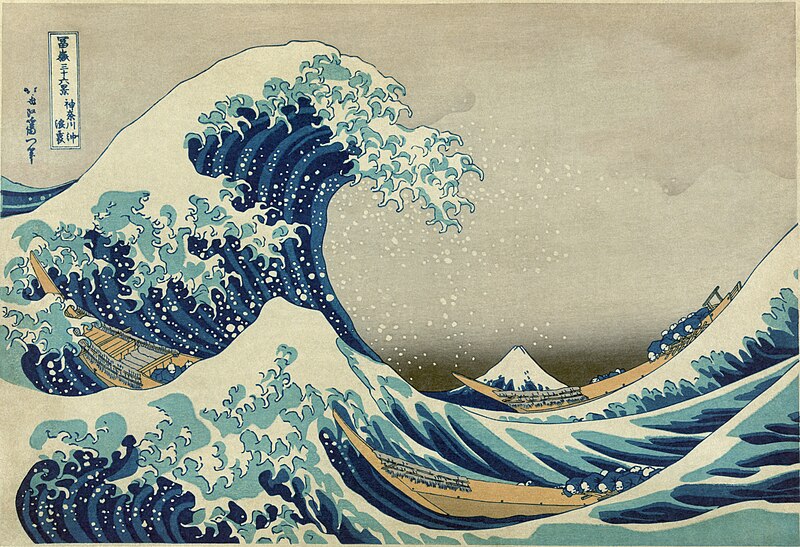 |
| Great Wave at Kanagawa* |
As I am currently seeking employment, I can't make future commitments and jot them down on a calender as I have no idea what my future holds. At this time my role as tenzo has many requests for my services coming into view and as paying the bills rates higher on my priorities, I'm not able to make the commitment now even if I have the time when it is requested.
This is both frustrating and disappointing as I not only take my role and responsibility seriously, my pleasure and generosity associated with it come from a very deep and sincere place inside of me. The sangha needs me and while things can happen without me, the greater burden placed on others will essentially be my fault if I'm not able to answer the call.
In my continuing exploration of non-duality, I see this relating to the polarity of form and emptiness. I see lack of form, and thus a great deal of emptiness in my days. I still get things done, even if it's not always what I should be doing, but moments come and go regardless. To restore balance, I need more form as my current situation is unsettling, like tumbling in the dark, or to return to the above metaphor: floating adrift.
I see the need to recognize both form and emptiness as the world doesn't end if a form falls apart, but right now the world is difficult to start without forms.
Floating is nice, but it's good to have an anchor or two.
-------------------------------------------------
*This iconic Hokusai print, borrowed from Wikimedia Commons, is an ukiyo-e image depicting boats of fishermen struggling against the sea. It shows a wonderful example of when it is appropriate to be flexible. These fishermen are brave and skillful, as they must push through the breakers to reach their fishing grounds. But there is a difference between being flexible and flaccid. Without effort, they would capsize and be crushed.

Monday, March 14, 2011
Words, What's the Point? or Stupid Non-Duality...
I'm sure it's just a stage, like those one passes through when dealing with grief. If that's the case, I have no choice but to fully throw myself into it and wallow in the frustrating paradox that is coming to grips with non-duality.
A big issue with Zen teachings is their stereotypical "illogical" nature made famous by the promotions of D.T. Suzuki.* I had pretty much wrapped my mind around the emptiness of words and how we shouldn't rely on them when practical experience is a better teacher, but having experienced directly a handful of things that, in the light (or should I say "darkness") of non-duality, are inexpressible in words; my heart has not been so pliant.
Remembering a post by Shundo at The Ino's Blog concerning the use of jargon at San Francisco's City Center, inspiration struck.
We're always told that only a realized teacher can confirm "enlightenment" experiences and I'd more or less just taken this on faith. They see that you get "it" enough, so yeah, the experience is valid. But when it comes to koans not having fixed answers, I just didn't understand how this could work.
Just as a visitor wouldn't really know what the "doshi door" was without experiencing it, we can't really know the true nature of anything without experiencing it. People can give descriptions, even show you pictures, but until you actually experience it, your only reference of the door is secondary sources, shallow imitations of the real deal.
In having misunderstands/disagreements about the meaning of terms, or even whole and fundamental teachings, with people online and in person, I do and have realized that we really are talking about the same thing, but that our concepts of what the words we use mean, are different.
I've long felt that people are who they are because they are comprised of their experiences, built up as individuals by a lifetime of events and influences.** All of these situations have determined how we see the world and how we define the things around us.
Words, being abstract representations of these experiences, only have meaning because we have all agreed up their meaning, this is how language develops. Someone says, "This is a ball, from now on, you see one of these and call it a ball, I'll know what you're talking about." Everyone agrees and we have one idea of what a ball is. Something else shaped the same way, the same size, color and everything pops up and we have a dilemma. Do we agree that this new object is a ball, too, or do we call it something else? So now we have criteria for what a ball is.***
But abstract ideas add a new dimension to this because we can't point to them. (I could write a whole book on this phenomena, but then I'd have wasted my time because that's what Zen and the Art of Motorcycle Maintenance is about.) I'm very fond of the idea of words as fingers pointing to the truth so this is a metaphor that pops up for me a lot.
Each moment of our existence is different from those around us, so the rules that we assign to our existence are different. Most notably the difference between right and wrong is a good example. Given an individual's upbringing the appropriate way to interact with authority figures can be drastically different, giving them a different sense of right and wrong. I could go deeper into this, but I hope you get where I'm going.
When it comes to our experience of reality, this causes trouble until we have an experience in which we glimpse its true nature. The words we use to communicate our experience to a teacher are direct references, and if we're lucky our words will point at the same thing our teacher's understanding looks towards. Until we have that experience ourselves (like seeing the doshi door) our fingers just point at other fingers and our experience isn't direct.
(I hope you're still with me.)
Words, unfortunately will always just point, so all I can do is point and hope you understand, not what I'm pointing to, but that this sign I'm holding up is understood to even point. So I'll just keep pointing, not expecting anyone to understand or even read this blog just like I did at the very beginning.
Maybe the mountains are becoming mountains again, they sure seem to be trying.
*I've more or less given up on his works as a practical reference as I don't think he really knew what he was talking about. Sure in a talking "about" way, he did. He was talking circles around the truth, but never pointing directly at it. Scholarly analysis just doesn't do Zen justice and as a practitioner, this was one of the first gates I passed through finally after ten years of intellectual study.
**Later Buddhism gave me a framework for expressing this. Since these are the heaps/aggregates/skandhas, that are fundamentally empty, the "face we had before our parents were born" is like the blank canvas or empty vessel that all of this goes into. This is not however, a belief of environment over genetics determining who we are since genetics have evolved as a response to the environment of our ancestors ("before our parents were born") as well as forms of life and even the planet, then stars, making the history of the entire universe influential in who we are in every moment of our lives. Thus, that "face" is the self independent of phenomena, the absolute primordial inexpressible action/actor.
***When I took an intro to philosophy class in college, one of our discussions was an epistemological argument concerning whether or not it was possible to distinguish whether one of two objects, having identical properties, was removed a second time from a box or if it was the one left behind the first time. Hating hypothetical questions for their assumptions, I questioned whether one of the identical properties was that it was really one object existing simultaneously in two places. This blew the lid off the conversation, effectively ruining it, but it's a hypothesis that's stuck with me. Eventually, I mean to post about this. (if you have a comment about this, just encourage me to write the post and we'll discuss it then)
A big issue with Zen teachings is their stereotypical "illogical" nature made famous by the promotions of D.T. Suzuki.* I had pretty much wrapped my mind around the emptiness of words and how we shouldn't rely on them when practical experience is a better teacher, but having experienced directly a handful of things that, in the light (or should I say "darkness") of non-duality, are inexpressible in words; my heart has not been so pliant.
Remembering a post by Shundo at The Ino's Blog concerning the use of jargon at San Francisco's City Center, inspiration struck.
We're always told that only a realized teacher can confirm "enlightenment" experiences and I'd more or less just taken this on faith. They see that you get "it" enough, so yeah, the experience is valid. But when it comes to koans not having fixed answers, I just didn't understand how this could work.
Just as a visitor wouldn't really know what the "doshi door" was without experiencing it, we can't really know the true nature of anything without experiencing it. People can give descriptions, even show you pictures, but until you actually experience it, your only reference of the door is secondary sources, shallow imitations of the real deal.
In having misunderstands/disagreements about the meaning of terms, or even whole and fundamental teachings, with people online and in person, I do and have realized that we really are talking about the same thing, but that our concepts of what the words we use mean, are different.
I've long felt that people are who they are because they are comprised of their experiences, built up as individuals by a lifetime of events and influences.** All of these situations have determined how we see the world and how we define the things around us.
Words, being abstract representations of these experiences, only have meaning because we have all agreed up their meaning, this is how language develops. Someone says, "This is a ball, from now on, you see one of these and call it a ball, I'll know what you're talking about." Everyone agrees and we have one idea of what a ball is. Something else shaped the same way, the same size, color and everything pops up and we have a dilemma. Do we agree that this new object is a ball, too, or do we call it something else? So now we have criteria for what a ball is.***
But abstract ideas add a new dimension to this because we can't point to them. (I could write a whole book on this phenomena, but then I'd have wasted my time because that's what Zen and the Art of Motorcycle Maintenance is about.) I'm very fond of the idea of words as fingers pointing to the truth so this is a metaphor that pops up for me a lot.
Each moment of our existence is different from those around us, so the rules that we assign to our existence are different. Most notably the difference between right and wrong is a good example. Given an individual's upbringing the appropriate way to interact with authority figures can be drastically different, giving them a different sense of right and wrong. I could go deeper into this, but I hope you get where I'm going.
When it comes to our experience of reality, this causes trouble until we have an experience in which we glimpse its true nature. The words we use to communicate our experience to a teacher are direct references, and if we're lucky our words will point at the same thing our teacher's understanding looks towards. Until we have that experience ourselves (like seeing the doshi door) our fingers just point at other fingers and our experience isn't direct.
(I hope you're still with me.)
Words, unfortunately will always just point, so all I can do is point and hope you understand, not what I'm pointing to, but that this sign I'm holding up is understood to even point. So I'll just keep pointing, not expecting anyone to understand or even read this blog just like I did at the very beginning.
Maybe the mountains are becoming mountains again, they sure seem to be trying.
-----------------------------------------------------
*I've more or less given up on his works as a practical reference as I don't think he really knew what he was talking about. Sure in a talking "about" way, he did. He was talking circles around the truth, but never pointing directly at it. Scholarly analysis just doesn't do Zen justice and as a practitioner, this was one of the first gates I passed through finally after ten years of intellectual study.
**Later Buddhism gave me a framework for expressing this. Since these are the heaps/aggregates/skandhas, that are fundamentally empty, the "face we had before our parents were born" is like the blank canvas or empty vessel that all of this goes into. This is not however, a belief of environment over genetics determining who we are since genetics have evolved as a response to the environment of our ancestors ("before our parents were born") as well as forms of life and even the planet, then stars, making the history of the entire universe influential in who we are in every moment of our lives. Thus, that "face" is the self independent of phenomena, the absolute primordial inexpressible action/actor.
***When I took an intro to philosophy class in college, one of our discussions was an epistemological argument concerning whether or not it was possible to distinguish whether one of two objects, having identical properties, was removed a second time from a box or if it was the one left behind the first time. Hating hypothetical questions for their assumptions, I questioned whether one of the identical properties was that it was really one object existing simultaneously in two places. This blew the lid off the conversation, effectively ruining it, but it's a hypothesis that's stuck with me. Eventually, I mean to post about this. (if you have a comment about this, just encourage me to write the post and we'll discuss it then)
Subscribe to:
Posts (Atom)